Diagnostic guide
Why Ants Keep Coming Back (and How to Find the Nest)
Six reasons a treated ant problem restarts, how to read which one you are looking at, and the field method for following a line of workers back to where they actually live.

A clear threshold on Tuesday means nothing by Friday if the colony was never touched.
Ants returning is not bad luck and it is rarely bad product. It means the ant nest producing those workers was never reached, or it was reached and something else out there is still producing more. Those are two different problems with two different fixes, and telling them apart takes observation rather than another trip to the hardware store.
This page is a diagnosis page. It lists the six reasons a Melbourne household ends up treating the same trail three summers running, gives you a way to work out which one applies, and then sets out how a technician actually follows workers back to a colony. The rating of home remedies and the baiting sequence are covered separately in Tim's library of pest guides, so this one stays on the question of why the result did not hold.
Expect it to take an evening of paying attention rather than an afternoon of work. The useful information is in where the ants go when nobody is cleaning, and that is only visible if you leave them alone long enough to watch.
The six reasons
Why do ants keep coming back after a treatment?
Because the colony survived, because a second colony was never found, because the product repelled instead of killing, because the bait was refused, because the conditions that attracted them were never changed, or because next door is untreated. Almost every repeat case in a Melbourne home traces back to one of those six, and each leaves a different fingerprint.
Working out which one you have is faster than guessing, because the pattern of the return gives it away. Use the table as a diagnosis rather than a list.
| What you are seeing | Most likely reason | What changes it |
|---|---|---|
| Same line, same spot, back in days | Foragers were killed, the colony was not | Something the workers carry home, placed on the line itself |
| Line gone, new line a metre away | A repellent product pushed them onto a fresh route | Stop spraying, let the original path re-establish, then bait it |
| One trail becomes two or three | The colony split and budded off under pressure | Treat every location at once, not one at a time |
| Bait untouched after a full day | The colony has switched what it wants | Swap sweet for protein or oil based, not one brand for another |
| Clean for weeks, then back each summer | An outdoor colony that reaches the house in hot or wet weather | External work and the conditions along the wall base |
| Back within a fortnight, every time | Recolonisation from an adjoining property | Treating the whole boundary, ideally with the neighbour |
Two of those deserve a longer word. Budding punishes effort, which is why careful people get caught by it. Under chemical pressure some species split, and a group of workers leaves with a queen to set up elsewhere on the property. Victorian guidance on ants is blunt about it: spraying can fragment a colony and worsen the problem, while baiting every location found is what works instead.
The other is the neighbour problem, which is not an excuse and is genuinely real. Argentine ants form nests that link across a whole area and exchange workers and queens between them without fighting, and official advice notes that a treated area can be recolonised from next door within a couple of weeks. In a townhouse row or a block of flats that mechanism is sitting right there in the shared wall.
Careful with the word stronger. The common response to a return is a harsher product, and with ants that usually makes the next attempt worse rather than better. Repellency is what scatters a colony and hides the nest. The correct escalation is a product the ants cannot detect, not one that knocks them down faster.
Field method
How do you track a trail back to the ant nest?
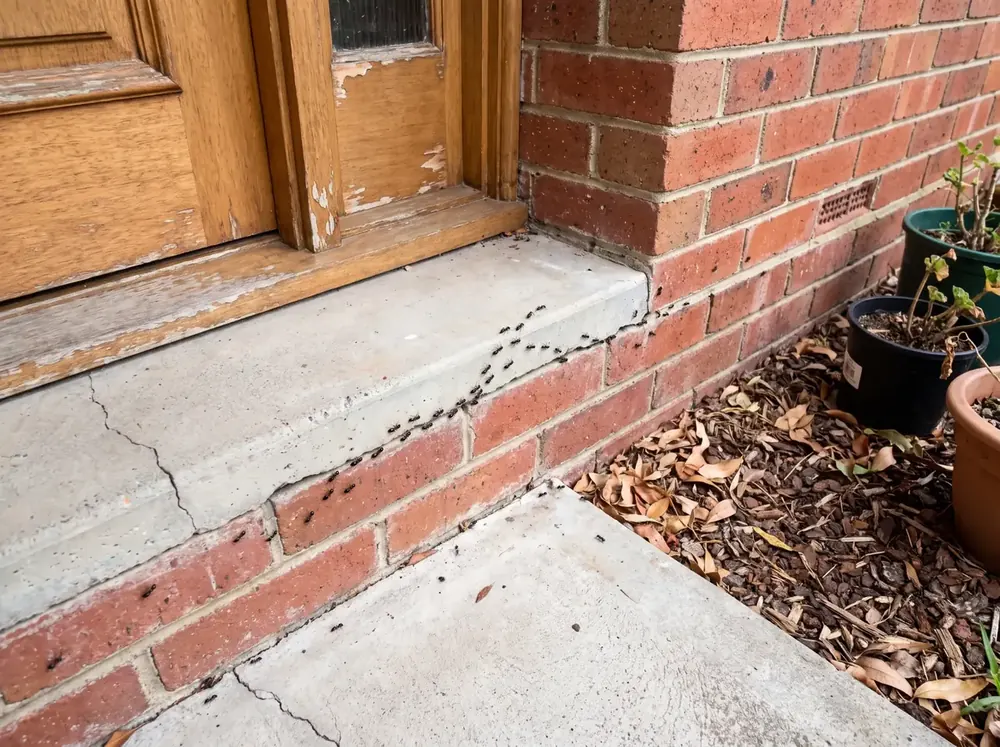
Put down something they want, wait for a steady two-way line to form, then follow the loaded workers rather than the empty ones. Ants carrying food walk home, so the direction of the full ones is the direction of the colony. Work in short stages at dusk, mark each stage, and expect it to run outside and down.
- Set a lureA smear of jam and a smear of tinned pet food on separate squares of card, left near the active area.
- Wait for the columnTwenty minutes or so. A proper two-way line is far easier to follow than scattered wanderers.
- Follow the loaded onesWorkers with a visible load are heading for the nest. Track them in metre stages, marking each one.
- Find where it leavesWeep hole, door threshold, pipe penetration, window reveal. That exit point is the half of the job most people skip.
Timing beats effort here. Sugar ants forage at night and are close to invisible in daylight, and most Melbourne kitchens see their heaviest traffic from late afternoon onwards. A torch with red cellophane taped over it lets you watch without pushing anything off the line.
- Follow the wall, not the floor. Ants run along edges and corners, so the line continues at the skirting even when it looks like it vanished.
- Check vertically. A line that disappears at a window reveal is usually going up inside the cavity, not stopping.
- Lift the obvious objects. Pot bases, pavers, doormats, the meter box, the hose reel bracket and stacked timber hide more colonies than anything else in a Melbourne yard.
- Watch for the second direction. Two columns leaving the same food in opposite directions means two separate colonies, and that changes the whole plan.
Not every trail ends somewhere you can see. A line that disappears into brickwork or under a slab has still given you the entry point and the direction, and product placed there works whether or not you ever set eyes on the colony.
A detail worth recording: write down the date, the room, the wall and the direction each time. Households that keep two or three lines of notes over a summer can usually tell a technician exactly where to start, and that is worth far more than describing the ants.
Hidden sites
Can a colony really live inside a wall or under the slab?
Yes, and in Melbourne it is common rather than unusual. Black house ants readily nest in ceilings, cavity walls and subfloors, coastal brown ants work their way into wall crevices and behind skirtings, and slab homes give colonies a warm dry run along the expansion joints and under the floor covering at the edges.
Houses built differently fail differently. Older weatherboard homes through the inner north sit on stumps with an open subfloor, so a colony lives in dry soil below and comes up through a floor gap. Brick veneer on a slab moves everything to the perimeter: the bottom course, the weep holes, the pipe penetration and the joint where slab meets path.
Warm, dry and never disturbed. The giveaway is a trail that appears at a power point, an architrave join or the top of a skirting rather than at floor level.
The joint between slab and path, and the strip under the floor covering at the wall, both hold warmth. Ants in a newish house with no garden usually come from here.
Stumped homes give a colony shelter with no weather. Access hatches, vents and the perimeter are where this one is dealt with.
A pot against a wall is a warm, moist, protected block of soil. Lifting one and finding brood underneath settles a lot of arguments.
Damp timber is the one finding that changes the conversation. Carpenter ants excavate wood that is already wet or rotting rather than sound timber, so finding them says there is water getting in somewhere. Treating the ants and leaving the leaking gutter, the failed shower seal or the blocked subfloor vent in place guarantees the same call next year. The difference between those galleries and real timber damage is covered in Tim's guide to telling carpenter ants from termites.
Honest weighting
How much does sealing the gaps actually help?
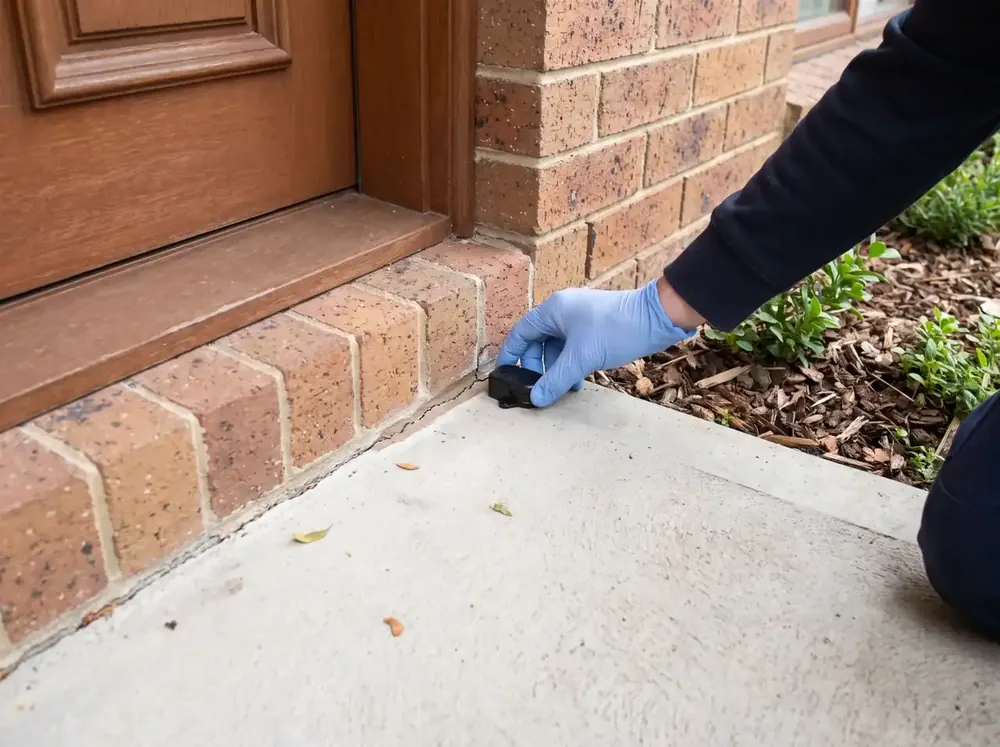
Sealing is worth real effort, but it is a second step rather than a first one. A determined colony finds new routes, and official ant guidance makes the point that any barrier has to be thorough because ants readily work around a partial one. Seal after the colony has been dealt with and it holds. Seal before, and you have redirected them.
The honest ranking is that reaching the colony does most of the work, removing what attracted them does the next slice, and sealing takes care of the remainder. Done in that order the result lasts. Done backwards it produces the classic complaint of a trail that moved rooms.
Which gaps are actually worth filling?
The ones that connect the outside wall to an internal space: the pipe penetration under the sink, the conduit behind the meter box, the gap where a vanity waste passes the wall, the air gap at a sliding door track and the join between an architrave and the plaster. Those are short runs of silicone or expanding foam that pay for themselves. Weep holes are a different case and should never be sealed, because they drain the cavity.
Do ant barriers sold in supermarkets do anything?
Chalk, powder lines and scented barriers break a scent trail for a short time and then get walked around. Melbourne adds a second problem for anything applied outdoors, because rain falls often enough that a treated strip rarely stays intact for long. They are not a reason to skip the work that reaches the colony.
What about the plants and mulch against the wall?
That is the highest value hour in this whole guide. Branches and climbers touching the wall or roof act as bridges over everything you do at ground level. Mulch piled against the brickwork keeps the base permanently moist. Pulling mulch back a hand's width, trimming contact points and lifting pots off the ground removes the conditions rather than the ants.
Why do they flood in after heavy rain?
Ground nests fill with water and the colony moves to the nearest dry high ground, which is often the cavity of your house. Melbourne's habit of raining every few days produces both versions of the problem: columns indoors after a downpour, and columns indoors during a dry spell when the same colonies come looking for water instead.
One more item belongs on this list and almost never makes it. Aphids and scale insects on a shrub produce honeydew, and ants farm them for it. A camellia, a citrus or a rose against the house can feed a colony all summer, and no indoor bait competes with that.
The limit
When should you stop working on it yourself?
Stop when you have run two full baiting cycles with no fall in activity, when trails are showing up on three or more walls, when the line is coming out of a cavity or slab you cannot open, or when a neighbouring property is clearly part of it. None of those four get better with another retail product.
- Two cycles, no change. The species is not taking bait, or the colony you are feeding is not the one sending the workers.
- Three or more trails. Linked or budded nests. They need treating together, in one go, which is hard to organise from a supermarket shelf.
- A cavity or slab run. Reaching it means dust and non-repellent product placed into voids through existing gaps.
- Ants in damp structural timber. Get the water problem identified as well as the ants, because the ants are a symptom of it.
What a proper visit should give you is also worth knowing, because it tells you whether the job was done or just attended. The species should be named out loud. Both sides of the wall should be treated, not just the one you complained about. Product belongs in voids, cracks and entry points, not across open benches. You should be told what the next fortnight will look like, including the rise in numbers that signals the bait was accepted, and the warranty should be in writing before anyone drives off.
At that point the job is ant control in Melbourne, which sets out the identification, the baiting and the external band in detail. Tim works under Victorian licence No. 86488, is fully insured, and backs covered ant work with a three month guarantee on the area he treated. If you want it looked at rather than explained, book a treatment visit and say which walls are active.
The ants you can see are the colony's opinion of your house. Change the opinion and the trail stops arguing.
Questions
Questions about ants that will not go away
How do I find where the ants are nesting?
Set a lure of jam and tinned pet food, wait for a steady two-way column, then follow the workers carrying a load, because those are the ones walking home. Track in short stages after sunset and mark each one. Expect the line to leave the building at a weep hole, a threshold or a pipe gap.
Why do they come back every single summer?
Usually an outdoor colony that is still there, reaching the house when heat or heavy rain pushes it to move. The indoor trail was the symptom, so clearing it changed nothing outside. External work plus removing the conditions along the wall base is what breaks that annual cycle.
Can ants nest inside a wall?
Yes. Black house ants and coastal brown ants both set up inside cavity walls, ceilings, subfloors and behind skirtings. The sign is a trail appearing at a power point, an architrave or the top of a skirting rather than at floor level. Treatment goes into the void through gaps that already exist.
My bait has not been touched in two days. What now?
Change the type rather than the brand. A colony's appetite moves between sweet and protein with whatever the brood needs, so last autumn's favourite gel can sit untouched all spring. Set one of each beside the other, let the ants pick, then stay with the winner.
Does the neighbour's yard really matter?
With some species it decides the outcome. Argentine ants run linked nests across whole areas and move workers and queens freely between them, and official advice notes a treated area can be repopulated from nearby within a fortnight. Where that is happening, treating both properties around the same time is the only version that holds.
Is one treatment enough to end it?
For a single straightforward colony, often yes. For budding species, several nests or a property that keeps getting repopulated, follow-up work is normal and anyone promising otherwise is overselling. The honest measure is whether activity falls and stays down, which is what a written guarantee period exists to test.
Third round of bait and they are still marching?
Tell Tim which rooms, which wall and how long it has been going, and he will say what the species is likely to be and what the visit would cost before you commit to anything.
Reviewed October 2026 by Tim, licensed pest control operator (Victorian licence No. 86488). Ant biology and control guidance: Victorian Department of Health. Choosing and checking an operator: Better Health Channel.