Service directory
Our Pest Control Services
Nine pests, each with a page of its own, plus the programs for inspections, businesses and rentals. Start with the table.

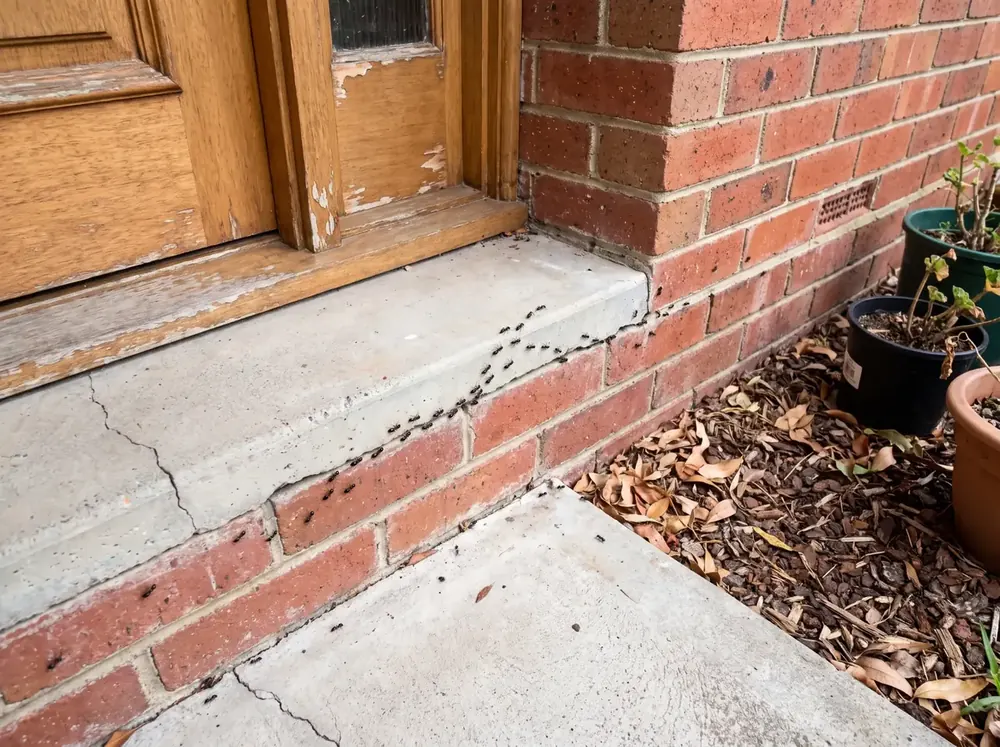
Most jobs start outside, at the wall base and the gaps around pipes, vents and thresholds.
This page is the directory for all of Tim's pest control services in Melbourne. Nine pests each get a page of their own, written around the species that actually turn up here, and seven kinds of job sit alongside them, from a single wasp nest on a Saturday to a scheduled visit at a cafe.
Tim is one licensed technician, not a call centre with a roster of contractors, so whoever prices your job is the one who does it and picks up afterwards. That matters most on jobs needing a second visit. All of it sits under pest control in Melbourne, which covers the method, the licence and the suburbs Tim reaches.
Four things are not on the list: termites, possums, bee swarms and bats. Two are a separate trade and two are protected animals. Tim says which on the first call rather than taking the booking anyway.
Start here
Which of these pest control services fits your problem?
Choose by the sign you have actually seen, not the worst thing it might be. Insects in a line along a bench edge is an ant job. Brown insects darting from behind the kettle is a cockroach job. Clustered welts overnight point at bed bugs. Scratching above the ceiling each evening is rodents.
The middle column is worth reading twice. Welts get blamed on fleas when bed bugs or carpet beetle hairs caused them, and a holed jumper gets blamed on moths when a beetle larva did the chewing.
| Pest | What you notice | How it is treated | Visits |
|---|---|---|---|
| Ants | A steady line along a bench, mortar joint or path edge | Bait matched to the species, plus an outside band | Usually one |
| Cockroaches | Brown insects scattering when the kitchen light goes on | Gel into hinges and voids, with a growth regulator | One, then a check |
| Spiders | Webs rebuilt overnight on window reveals and eaves | Webs and egg sacs down first, then sheltered surfaces | Usually one |
| Rats and mice | Droppings in a drawer, chewed packets, night scratching | Secured stations or traps, plus a list of gaps to close | Two or three |
| Bed bugs | Rust spots on a mattress seam, skins behind the bedhead | Staged work on beds and surrounds, follow-up booked | Two |
| Wasps | A flight line into one hole, or a papery nest on an eave | Direct treatment at the nest entrance, in gear | Usually one |
| Fleas | Ankle bites and dark specks in the pet's bedding | Floor edges, rugs, subfloor and shaded yard areas | One or two |
| Mosquitoes | A whine at dusk and welts after half an hour outside | Breeding water fixed, then shaded resting foliage | Seasonal |
| Moths | Webbing in dry goods, holes in wool, casings in wardrobes | Source packet or carpet edge, then the harbourage | Usually one |
Ants
Ants: why does the species change the treatment?
Different ants eat different things, so a bait one colony empties overnight gets ignored by the next. Black house ants take sweet gels. Coastal brown ants, the ones pushing soil piles up between pavers, want protein and oil instead. Guess wrong and the colony grows under a product it never touched.
Whatever is on your bench is a forager, so the treatment has to be something carried back. Two species get pages of their own: carpenter ants hollow out damp timber, and bull ants and jack jumpers nest in the ground and sting hard.
Cockroaches
Cockroaches: why does a kitchen job need a second look?
German cockroach eggs sit in a hard case that shrugs off most products, so a visit that clears every adult can still be followed by a hatch a fortnight later. A growth regulator plus a return check breaks that cycle. The big outdoor species trace back to a drain or subfloor.
Kitchens cleaned daily still get cockroaches. The harbourage sits inside warm equipment: a fridge motor housing, the gap behind a dishwasher, a kettle base. Wiping surfaces reaches none of it, and spray scatters them into fresh cupboards. If they are small, pale brown and striped behind the head, read the German cockroach page.

Spiders
Spiders: what does taking the webs down achieve?
Clearing webs and egg sacs by hand is what makes the work visible and stops next season's spiderlings hatching where you stand. Spray alone leaves the old webbing hanging, so the job looks untouched. Product then goes onto the surfaces spiders walk across rather than into the air.
Scope is the real argument here. A price covering the house walls alone leaves the pergola, retaining wall cavities, stacked pots, shed and letterbox untreated, and that is where redbacks settle. Two local worries: funnel-web species that cause serious injury are not found in Victoria, and the old story linking white-tail bites to flesh-destroying ulcers has never been established in medical studies. The guide to Melbourne spiders sorts the rest.
Is one web three weeks later a sign the treatment failed?
No. Spiders walk in from next door all year, and a residual product is not a force field. What should change is how many there are and how long they last on treated surfaces. Webs back in volume, rather than one at a time, is worth a call under the guarantee.
Rats and mice
Rodents: is the bait or the gap the bigger half?
The gap is. Bait clears the animals in the building now, while proofing decides whether a new family moves in next autumn. Tim does both, sets stations where a child or a dog cannot reach them, and leaves a written list of openings to close with the materials that hold.
Signs arrive in order from about April: droppings somewhere enclosed, chewed packaging, scurrying at the same time each night, then a greasy smear along a joist. Rats and mice need separate thinking, so there are pages for mice in homes and roof spaces and for rat control.

Bed bugs
Bed bugs: why is preparation half the result?
Because what the household does in the two days either side of the visit decides whether it holds. Bedding goes through a hot wash and a hot dryer, clutter comes off the floor, and nothing leaves the room, because a mattress dragged to the lounge seeds a fresh infestation in the lounge.
Early signs are easy to dismiss: rust-coloured marks on mattress piping, pale shed skins in a bed frame joint, dark specks inside a power point cover. Bites never confirm it alone.
- Do not bomb the room. Foggers push bugs deeper into frames.
- Do not bin the bed before the inspection. It is rarely needed and it spreads them.
- Expect two visits. Eggs survive the first round, so the follow-up is part of the job.
- Say where else you slept since the bites started, so those rooms get checked too.
The Better Health Channel notes bed bugs are hitchhikers, not a sign of a dirty home. To check first, work through the bed bug inspection guide with a torch.
Wasps
Wasps: when does a nest stop being a job you can handle?
Once it is a European wasp nest, once it sits inside a wall or the ground, or once it is beside a door, a play area or a bin used daily. All three put someone within range of a colony that defends itself in numbers, and the Better Health Channel recommends a licensed operator.
Smooth yellow and black, with a flight line into one small hole in soil, brickwork or a vent. The colony gets very large by late summer, stings repeatedly, and comes back at whoever disturbed it.
A small open nest shaped like an upside-down umbrella with the cells showing. Less aggressive, still a problem over a doorway. One visit.
Clay cells stuck to a wall, frame or shed rafter. Solitary, barely interested in people, often better scraped off than treated.
Settle one thing on the phone: a honey bee swarm is not a wasp nest, and bees are not treated here. Bees clustered on a fence post are usually worth saving, and a beekeeper will often take them away alive. Detail on all three wasps sits on the European wasp nest page.
Fleas, mosquitoes, moths
Fleas, mosquitoes and moths: who treats what?
These three split the work between Tim, your vet and you. Tim treats the building and the yard, the vet treats the animal, and the household does the vacuuming, the tipping out of water and the sealing of dry goods. Drop one and the others underperform.
- Fleas: the carpet is the reservoir, not the pet. Empty homes come alive on day one.
- Mosquitoes: saucers, tank overflows and blocked gutters beat spraying.
- Pantry moths: larvae pupate in shelf-pin holes, so a clean-out leaves the next lot behind.
- Carpet and clothes moths: damage sits in the edge strip, where vacuuming never goes.
Victorian health advice treats November as the start of mosquito season, so a yard assessment in spring beats a callout in January. See the guide to fleas in carpet for what to do between visits.

Programs
Which programs sit behind the single treatments?
Seven of them, and most households never need one. A single targeted treatment handles the large majority of home jobs. Programs exist for what one visit cannot answer: a purchase about to settle, a food business with an auditor, a tenancy ending, or an urgent nest.
A visit every six months is not a plan by itself. Without identification, a reason and some proofing, a recurring fee is a subscription. Ask what the schedule prevents.
Next step
How do you book the right service?
Send a photo plus three facts: your suburb, where you are seeing it, and roughly when it started. That is usually enough for Tim to name the pest, say whether one visit will do, and give you a price to approve before anything is applied.
- Describe itPhoto, suburb, rooms involved, and anyone with asthma, allergies or pets.
- Approve the priceThe pest named, areas included, follow-up or not, and the guarantee terms.
- Treatment and reviewPreparation and re-entry instructions, then a check that it held.
On price: the figure moves with the pest, the property size and storeys, the spread of the problem, and whether a return visit is counted in. Typical bands sit in the Melbourne pest control price guide. To go ahead, book a pest control treatment and Tim replies with a time.
Questions
What people ask before booking a service
Can one visit treat several pests?
Often yes. Ants, spiders and cockroaches overlap enough in method to be handled together, and the quote names each one. Bed bugs and rodents do not fold in neatly, since one needs staged bedroom work and the other needs stations and proofing. List everything you have seen.
Do you offer ongoing plans?
Yes, although most homes do not need one. A yearly visit suits households that get the same two or three pests every warm season, and scheduled visits suit food businesses with records to keep. For one ant trail, a single treatment with a guarantee behind it is enough.
Which pests do you not treat?
Termites, possums, bees and bats. Termite work is a separate licensed trade with its own detection gear and monitoring. Victoria protects possums and bats, so they need a licensed handler or a wildlife rescue group. A beekeeper takes the swarm. You get the referral on the first call.
What happens if the pest comes back?
Covered work carries a three-month re-treatment promise: if the same pest turns up in the area that was treated, Tim returns and treats it again at no cost. Which treatments are covered varies, so ask for your job's terms in writing with the quote instead of taking them verbally.
Not sure which service to book?
A photo, your suburb and a line about what you have noticed is enough for Tim to name the likely pest and the treatment.
Sources: the Better Health Channel pages on hiring pest control services and on the European wasp, plus Victorian pest control licensing.