Wyndham west
Pest Control in Tarneit
Half of Tarneit is still a building site, and that is exactly what drives the local pest calls. Treatment built around bare ground, new slabs and fences with nothing growing over them yet.
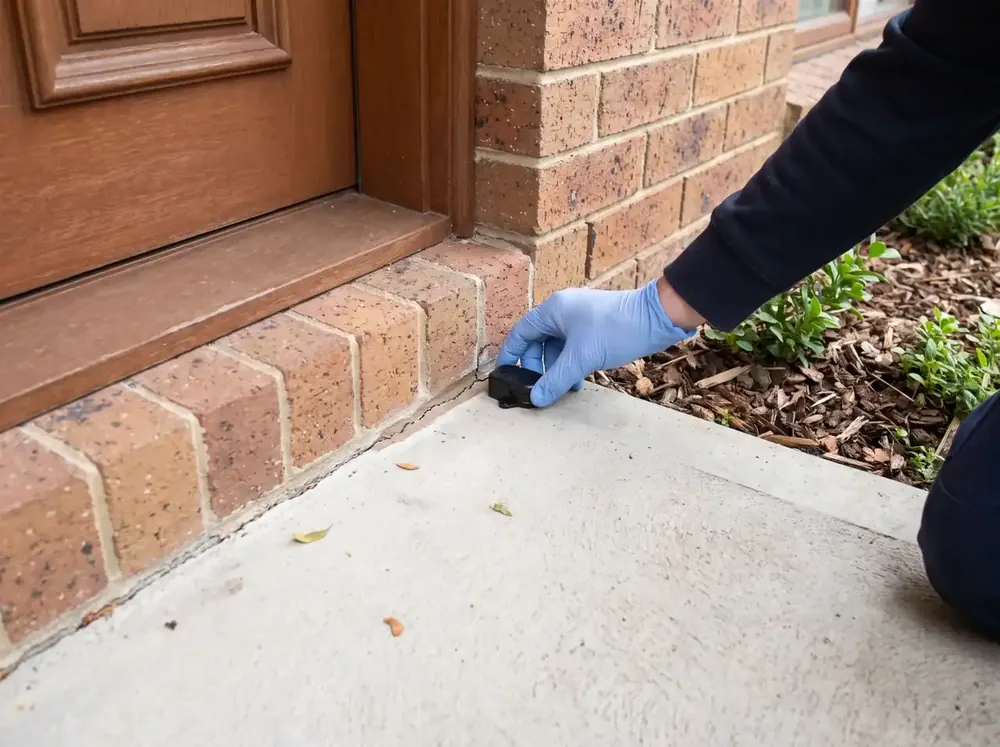
On a slab-on-ground house, the slab edge and the weep holes are where the job starts.
There is a reason pest control Tarneit jobs look nothing like a call from Hawthorn. Out here the ground keeps moving. Trenches get dug, slabs poured, topsoil stockpiled and grassland scraped flat, and each of those evicts something that was already living there. It has to go somewhere, and the nearest finished house with a warm kitchen is the obvious choice.
Tim's Pest Control works the western corridor, and Tarneit sits among the Melbourne suburbs on Tim's service list. His coverage takes in Melbourne plus the suburbs beyond it, reaching roughly 40 km out from the middle of the city, so Tarneit is well inside the line. He is not a local operator with a Tarneit address and does not claim to be, just a licensed technician who works this side of town often.
Below: what the construction activity actually pushes indoors, why a slab-on-ground house gets ants the way it does, why the spiders are so visible here, and how a booking is arranged.
Bare ground
What is driving the pest pressure in Tarneit right now?
Earthworks, mostly. Tarneit sits on the volcanic plains, and turning that grassland into streets means disturbing ground nests, displacing field mice and removing the cover that kept them out of the suburb in the first place. Until an estate is fully built out and the planting matures, the pests have nowhere to go except the finished houses.
The stage your street is at makes a measurable difference to what you see indoors.
- Vacant lot next door: grass and rubble, the best mouse and spider habitat on the street.
- Slab just poured: trenching and compaction have broken open ant nests, and the colonies relocate towards the nearest moisture.
- Frame up, bricks going on: a dry sheltered cavity with no occupants yet, which spiders and rodents take straight away.
- Street finished and planted: pressure settles down, and the problems that remain are the ones that got in and stayed.
- Displacement
- What happens when earthworks break open a nest or clear a habitat. The animals do not die with the disturbance; they move a short distance and re-establish, which is why pest calls here often follow construction next door by a week or two.
The other local factor is water. The Werribee River corridor, Davis Creek and the retarding basins that estates are built around hold water after rain, and mosquitoes breed in remarkably little of it. Victoria runs mosquito surveillance from November through the warmer months for exactly that reason, and a container of rainwater in your own yard will do just as well as the wetland down the road.
New builds
Which pests come with a brand new block?
Ants and spiders lead by a wide margin, with mice close behind in the streets that still back onto open land. New houses are not cleaner than old ones in pest terms, they are just different: no subfloor to patrol, no mature canopy for shade, and a slab edge that offers a direct run from the soil into the cavity.
Ants at the slab edge
They nest in the fill and the paving sand, then move in through weep holes and the perimeter joint. Baiting beats spraying, because the nest is the problem.
Black house and sugar ant treatmentSpiders on everything
Fences, eaves, letterboxes, downpipes and play equipment. With no tree canopy, your house is the tallest thing on the block.
How spider treatments are doneCockroaches indoors
Usually arriving with boxes, appliances or a delivery rather than coming up from a drain, and then staying in the warm.
Cockroach work in TarneitRedbacks deserve their own mention. New retaining walls, stacked pots, meter boxes, trailer draw bars, the underside of outdoor settings and the frames of play equipment are all prime redback real estate, and they appear on new blocks faster than most people expect. Only the female bite is a concern, and current first aid advice is a cold pack rather than a pressure bandage. Get medical help for anything more than local pain and swelling. The guide to identifying redback spiders has the detail and the photos.
One thing Tarneit does not have is funnel-webs. The species capable of serious harm are not found in Victoria, whatever a neighbourhood social media post says, and nothing you find in a Wyndham backyard is one.
Why so obvious
Why are the spiders so visible out here?
Because there is nothing else for them to build on. In an established suburb, webs go up in trees, hedges and old fences and you never notice. In a Tarneit estate the street trees are saplings, the gardens are new and the tallest structures are your house and your fence, so every web ends up somewhere you walk past.
Nothing has gone wrong at your place. Your house is simply the best structure in the street for a web.
It also explains why clearing webs matters so much here. A brush and pole takes down the egg sacs and the anchor points as well as the webs, so the treated band on eaves, fence capping and window reveals meets spiders arriving fresh rather than ones already dug in.
Expect the effect to fade as the estate matures. Once the street trees have some height and the gardens fill in, the webs move off the house and into the planting, which is where everyone would rather they were.

The diary
How far ahead should pest control Tarneit work be booked?
Not far. Most weeks a Tarneit job can be fitted into the same week, and the day comes down to how the western run lines up. Spring and early summer are the busiest stretch out here, so a few days' notice in October gets you a better choice of times than a Friday afternoon call in January.
- Send the detailA photo, your estate, the room or the part of the yard, and how long it has been going on. That is usually enough to name the pest.
- Approve the priceOne figure for the work described, agreed before the visit. Nothing extra appears on the invoice afterwards.
On the day the practical things matter. Side gates on new blocks are often still builder-fitted and stiff, the setback can be under a metre, and a perimeter treatment means getting the whole way around the house. Move the bins, shift the trailer, keep the dog in, and the visit runs to time.
Credentials are worth checking on anyone you let through that gate. Tim operates under Victorian pest control licence 86488, is fully insured, and the licence register is public for exactly this purpose. Treatments he covers run with a three-month guarantee, so a repeat appearance of the same pest in the area he worked on means a free return.
What happens next
What happens when you get in touch?
You describe it, Tim identifies it, you get a method and a price, and only then is a time held. Nothing is booked before you have agreed to the figure, and if the honest answer is that you do not need a treatment at all, that is what you will be told.
- Pet-safe placement is available on request, with baits in enclosed spots and a drying time given before Tim leaves.
- Kids and allergies change the plan, so mention asthma, pregnancy, babies, birds, fish or reptiles up front.
- Multiple pests get handled in one visit where possible rather than two separate bookings.
- Termites, possums, bees and bats are referred out, and a photo is usually enough for Tim to say which one it is.
Before any mosquito work: tip out anything in the yard holding water. Plant saucers, buckets, wheelbarrows, blocked grates, a pool cover with a puddle on it. A breeding site at your own back fence will undo an otherwise good treatment.
When it suits you, tell Tim about the job and you will get the identification, the plan and the figure before any date is set aside. If you are still comparing operators, the cost guide for pest treatments explains what actually changes a quote, and the Melbourne pest control overview lists every pest he handles. Werribee and Point Cook sit on the same run, so pest control in Werribee is often booked on the same day.
Questions
What Tarneit callers ask
Do you cover all of Tarneit?
Yes, all of it, from the older streets near Tarneit Road out to the newest releases along the river, plus Truganina, Hoppers Crossing, Werribee and Point Cook. Houses, townhouses, rentals and local businesses are all treated. Give Tim your estate name and he will know roughly what stage the street is at.
How soon can you come to Tarneit?
Usually inside the same week. Spring and early summer are busier, so it is worth ringing a few days ahead if the job can wait. Anything urgent, such as a wasp nest near a doorway or redbacks where children play, gets pushed forward rather than queued.
Businesses too?
Yes. Shops, takeaways, childcare centres, medical suites and the warehouses out towards Truganina are all serviced, with a written record of each visit for your own compliance file. Work can be scheduled outside opening hours so nothing happens while customers are in the building.
Will a treatment stop the pests coming back from the building site next door?
It will not stop the site, but it changes what reaches you. A treated perimeter plus sealed weep holes and door gaps means the ones that get displaced go elsewhere. While heavy earthworks continue nearby, a follow-up before summer is a sensible plan rather than an upsell.
Got something crawling through a brand new house?
A photo and your estate name are usually enough for Tim to name it and tell you what the treatment involves.
Sources: Better Health Channel on bites and stings and Better Health Channel on mosquitoes.