Service area
Pest Control in Melbourne Suburbs: Where Tim Works
Twelve suburbs have a page of their own here, because the houses and the pests in them are not the same. Everywhere else in the metro area is still covered.

One technician, one van, and a drive time that decides which day he can reach your street.
Pest control in Melbourne suburbs is not one job copied out two hundred times. A 2018 slab-on-ground house in Tarneit with weep holes a boot-width off the soil has different weak points from a Victorian terrace in East Melbourne sharing a roof cavity with two neighbours. The pest that calls first is different too.
So this page is organised by direction rather than by alphabet. Each group says what the housing is generally like and which pests Tim gets called out for there, with a link to the suburb page holding the detail. The nine pests and the method behind each are listed under pest control in Melbourne.
If your suburb is not named anywhere on this page, it is still worth asking. Most of the metro area is reachable, and the only real limit is how long the drive takes.
Coverage
Where does Tim travel for pest control in Melbourne suburbs?
Across greater Melbourne, about 40 km in each direction from the city, in five broad groups: north through Hume, east to Whitehorse, south-east along the Dandenong and Pakenham corridors, west through Wyndham, and the inner ring either side of the river. Twelve of those suburbs carry a page of their own. The rest are covered by arrangement, and your suburb largely decides which day Tim can get there.
| Direction | Housing, in general | Most common call |
|---|---|---|
| North | 1990s to recent estates where the street meets open paddock | Mice, then ants and spiders |
| East | Post-war brick and weatherboard, plus new towers and a food strip | Cockroaches and rats |
| South-east | Older industrial fringe through to brand new family estates | Rodents, wasps, large cockroaches |
| West | Volume-built estates on cleared farmland, young gardens | Ants and spiders, mosquitoes near water |
| Inner | Terraces, warehouse conversions and apartments with no side access | Rodents and German cockroaches |
The radius is a guide, not a fence. It is measured in driving time rather than with a compass, so a suburb 45 km out on a freeway can be easier to reach than one 30 km away across the middle of the city at four in the afternoon.
North
Why do the northern estates ring about rodents?
Because the suburb stops and the paddock starts, often within one street. When grass dries off, when a crop comes down or when the first proper cold snap arrives, field mice do not die out. They move to the nearest warm cavity with food in it, and a new estate on the edge of open land is exactly that. The pipe collars and roller door seals on newer houses are where they get in.
- Pest control in Craigieburn covers a long mix: 1990s brick veneer, mid-2000s courts and new releases still backing onto grassland. Rodent work there is as much sealing as baiting.
- Pest control in Roxburgh Park deals with tighter blocks, shared fence lines and garages built right to the boundary, which is where spiders and ants concentrate alongside the mice.
Roof voids in these estates are usually easy to get into, which helps. Finding the run along a top plate beats guessing from inside a cupboard.

East
What makes Box Hill a cockroach job more often than an ant one?
Density and food. Box Hill pairs post-war brick and weatherboard houses on mature gardens with a tight cluster of apartment towers, grocers and restaurants around the station. German cockroaches and rats travel between units, bin rooms and kitchens through shared services, so the problem is rarely contained to the flat that reports it. Mature trees and old brick fences keep the spider and ant work going too.
Plantings against the walls, old weep holes and subfloor vents. Spiders, ants and the occasional rat.
Risers, ceiling voids and bin rooms move cockroaches between flats. One unit treated in isolation buys weeks, not months.
Kitchens, storerooms and loading bays within a block. Nearby houses feel it too.
How that plays out street by street, and what it means if you are renting in a tower, is set out on pest control in Box Hill.
South-east
What drives the call-outs through Dandenong, Cranbourne and Officer?
Three fairly different places sharing one road out of town. Dandenong is older housing wrapped around an industrial and market area. Cranbourne is broad family estates on sandy ground with bushland at the edges. Officer is the newest of the three, built on former paddocks and nursery land along the Pakenham line. The pests follow those differences closely.
Dandenong
Factories, food wholesalers and 1950s houses with open drains and subfloors. Rats and the big outdoor cockroach species dominate the diary.
Pest control in DandenongCranbourne
Large estates, sandy soil that suits nesting ants, and reserves nearby that put wasps and spiders against the back fence every summer.
Pest control in CranbourneOfficer
New slabs, bare young gardens and bush on three sides. Wasp nests under eaves and mice from the surrounding paddocks are the usual two.
Pest control in OfficerOfficer and the far side of Cranbourne sit at the outer edge of the usual range, so those bookings get confirmed rather than assumed. Ask when you enquire and you get a straight answer.
West
Why do the western growth suburbs call about ants and spiders?
Because the estates were built over the top of what was already living there. Clearing farmland and grassland for housing does not remove ant colonies or spiders, it relocates their pressure onto the nearest structure. Add thin topsoil over clay, weep holes close to ground level, fresh mulch pushed against new brickwork and drainage reserves holding water, and you have the four most common western call-outs in one street.
- Pest control in Werribee spans an older town area with weatherboard and mid-century brick plus newer estates around it, so jobs range from subfloor rodents to estate ant trails.
- Pest control in Hoppers Crossing is largely 1980s and 1990s brick veneer with established gardens, which is prime territory for black house ants and web-building spiders.
- Pest control in Point Cook adds the coastal wetland factor: standing water in reserves and drains near the bay keeps mosquito enquiries coming through summer.
- Pest control in Tarneit is the newest of the four, with narrow side setbacks, double-storey walls that are hard to reach and land still being turned over nearby.
Cockroaches sit close behind in all four, which is why each of those suburbs also has a cockroach page.
Inner
What is different about an inner-city job?
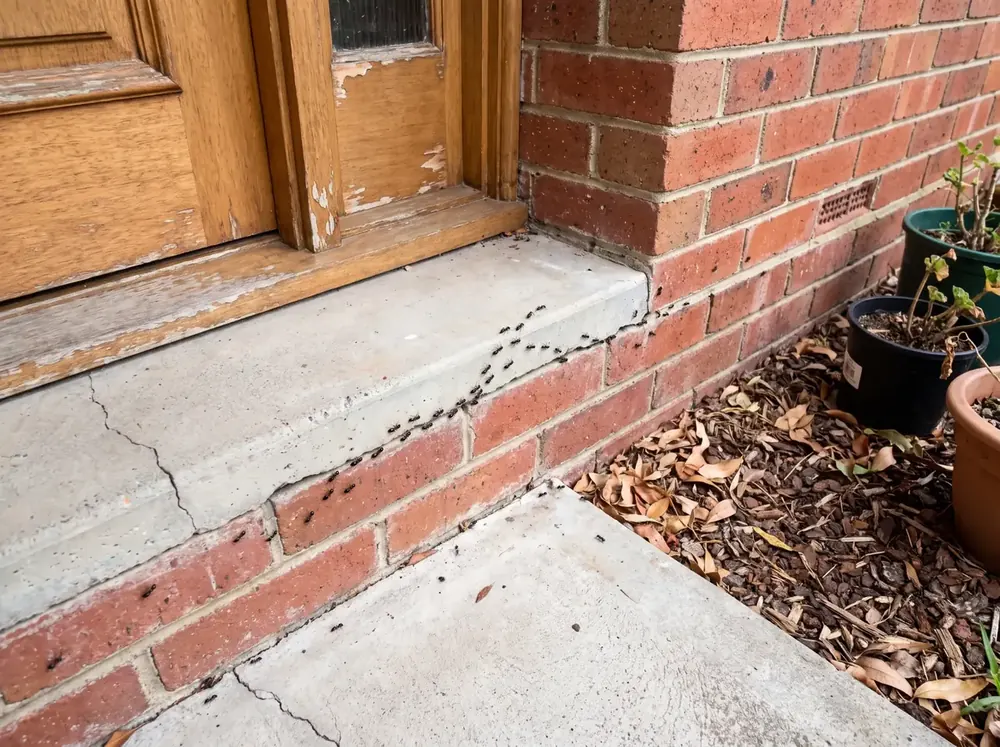
Access, shared structure and permission. Inner suburbs mean no side gate to walk product around, roof and wall cavities shared with the house next door, bin rooms held by an owners corporation and parking that has to be worked out before the van leaves. The pest is usually easier to identify there than the question of who is responsible for treating it.
Terraces, old brickwork and apartment conversions sharing one continuous roof space across several dwellings, so rodents travel the line rather than the front door. More on pest control in East Melbourne.
Workers' cottages, warehouse conversions and newer townhouses beside a working port and a busy row of kitchens, where rats and German cockroaches follow the food. See pest control in Port Melbourne.
In a block of flats the honest answer is often that the source sits in common property. Tim says so, treats what he was engaged to treat, and writes down what the body corporate needs to fix.
Everywhere else
Which other suburbs does Tim get to?
Plenty that have no page of their own. Twelve suburbs are written up here because enough people in them look for local detail to make it worth the words. Regular work happens well beyond that list, and the service is identical: same licence, same products, same guarantee, same technician at the door.
Those nine come up often enough to name. Beyond them the practical limit takes in most of Whitehorse, Monash, Darebin, Hume, Wyndham, Greater Dandenong and the bay side either way. Melton, Pakenham or the peninsula is a conversation rather than a flat no.
Do not assume from a map: two suburbs the same distance out can be a 25-minute drive apart. Give Tim the suburb and he will tell you what he can offer rather than quoting a radius back at you.
Next step
How do you get a treatment booked in your suburb?
Name the suburb, say what you have seen and where, and ask the question directly. You get back whether Tim covers you, what the pest most likely is, what he would do about it and what that costs, before anything is locked in. If the answer is that he cannot reach you, you hear that first rather than last.
Rentals, houses, units and small businesses are handled the same way in all of these suburbs, and the price does not shift because of the postcode. Send it through from the pest control booking page or ring and talk it over.
Questions
Service area questions
Is there a call-out fee on top of the treatment?
No separate call-out charge is bolted on afterwards. The treatment figure Tim quotes is the one you approve and the one you pay, and reaching you inside the usual area is part of it. A job well beyond the normal range gets discussed before you agree to anything.
How far from the city will Tim actually travel?
Roughly 40 km, measured by how long the drive takes rather than by a line on a map. Suburbs at the far edge, including Officer and the outer parts of Cranbourne, are confirmed case by case. Send your suburb and you will be told yes or no in the first reply.
Do you treat rentals and apartments in these suburbs?
Yes, and both are common work. In a Victorian rental, who pays usually turns on the cause: a pest present at move-in or getting in through a building fault points one way, and a problem tied to how the home is used points the other. A dated written report settles it.
Why do only twelve suburbs have a page of their own?
Because a thin page for every suburb in Melbourne would help nobody. These twelve have enough genuine local searching behind them to justify real detail about the housing and the pests. Everywhere else gets the same technician and the same terms without the padded page.
Not sure your street makes the list?
Send the suburb with a line about what you have been seeing, and Tim will say whether he can get there and roughly when.
Sources: Consumer Affairs Victoria on renting responsibilities and the Better Health Channel on pest control services.