Business sites
Commercial Pest Control in Melbourne
Scheduled visits, visits timed around trading, and a written record of every one. Set up so the paperwork is already on file the day somebody asks to see it.

The back of house is where a commercial program earns its keep.
Commercial pest control in Melbourne is judged on paperwork as much as on results. A householder wants the cockroaches gone, full stop. A venue manager wants them gone, wants evidence the site was checked last month, and wants that evidence in a folder when an officer from the council walks in without an appointment. Nine pests, the same registered products, a very different job.
Tim's Pest Control services cafes, restaurants, offices, accommodation, owners corporation common areas and small storage and workshop sites around greater Melbourne. Every attendance is made by Tim himself, which means the technician signing your service report is the one who actually walked the premises. Business work is normally set up as a standing schedule rather than a run of unconnected call-outs, and it is listed among Tim's pest control programs and services with the other recurring plans.
What follows is the practical side: the trading risk a single sighting creates, what the food rules genuinely ask of an operator, how visits are fitted around opening hours, the three parts of a site that cause most of the trouble, what belongs on a service report, and how the four main sectors differ from one another.
The brief
What does commercial pest control in Melbourne involve?
Three things a home job never needs: a schedule, a paper trail and timing that respects your trade. The treatment itself is only the visible part. The rest is a set visit frequency, a written record after each attendance, product choices allowed in a food or public area, and work carried out when customers and staff are not standing in it.
A sighting on a business site is not a nuisance, it is a trading problem. Staff see it before you do and talk about it. A customer who sees it reaches for a phone, and a photograph posted publicly outlasts the pest by years. On a food premises an inspection can arrive on any ordinary Tuesday, and most food businesses in Victoria are registered with and regulated by their local council, so the person asking the questions has statutory backing and a form to fill in.
- Scheduled pest program
- A standing arrangement where a site is attended at an agreed frequency, treated and monitored to a written plan, with a dated report produced each visit, rather than a technician being called only after something is spotted.
Something has been seen and needs treating now. Appropriate for a single wasp nest or a one-room flea job, and it leaves no record of the months either side.
Set visits at a frequency matched to the site, with monitoring between them and a report filed after each attendance. What auditors and councils expect to see.
Date, findings, product, location and recommendations, issued after the visit so the folder stays current without anyone chasing it.
Timing is the other half of the brief. A kitchen cannot have gel placed along a cook line at midday, a hotel corridor cannot be treated while luggage trolleys are moving through it, and an office floor cannot smell of anything on Monday morning. Availability outside trading hours is [after-hours availability to confirm]. Where a visit has to happen during trade, the order of work changes instead: back of house first, public areas last, and nothing applied where people are about to stand.
Scope matters too. There are nine pests on Tim's list: ants and cockroaches, spiders, rats and mice, fleas and bed bugs, wasps, moths and mosquitoes. Termites go to a timber pest specialist, possums to a licensed wildlife handler, bees to a beekeeper and bats to wildlife rescue, and he says which one you need on the phone rather than attending and charging for a look. The same nine pests and the same licence sit behind the residential side of Tim's pest control work around Melbourne.
Food premises
How does pest control work in a kitchen that never really closes?
By working to a plan, in the gaps, with products allowed in a food area. Food Standards Australia New Zealand says a food business must do everything it reasonably can to stop pests getting in or living on the premises, and to get rid of any that do. That turns into a site plan, a set frequency, and placements that keep product and dead insects away from anything food touches.
Food Standards sets out what good practice looks like under Standard 3.2.2. A pest management plan naming the pests and treatments involved, the areas to be inspected and treated including behind appliances and inside cavities, where any devices and pesticides sit, and a map of the site. Devices must not allow pesticide or dead pests to reach food or food contact surfaces. Only products cleared for use in food premises go in, and the inspection frequency is set by the site: its location, its climate, what it makes and how much activity has been seen.
The cook line
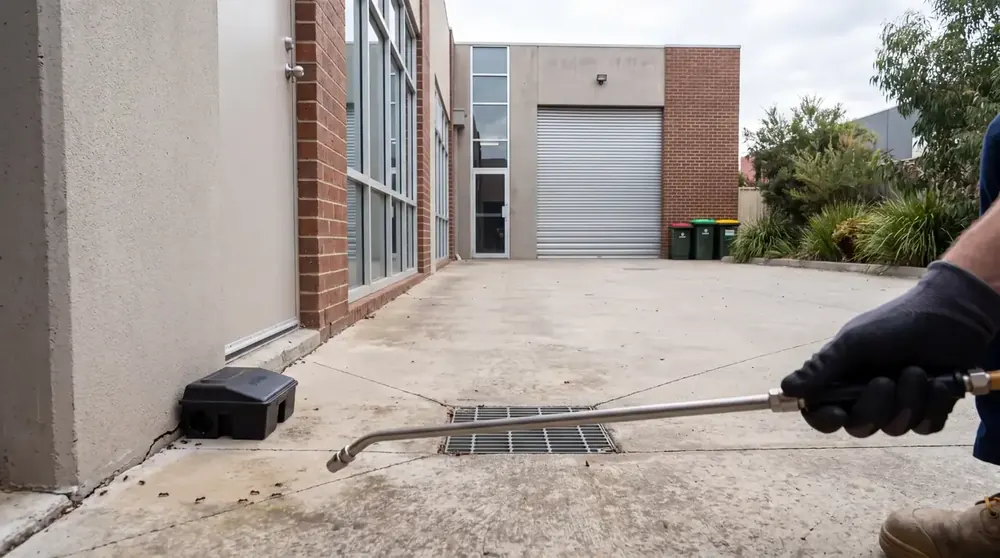
Heat, grease and cavities. Under the char grill, behind the bain marie, inside the splashback gap and along the cable runs feeding the benches. German cockroaches breed in the warmth here and nowhere else on site comes close.
The dry store
Cardboard arrives with the stock. Pallets on the floor, boxes against walls and open bulk bags give rodents and pantry moths both food and cover, and a stacked store cannot be inspected properly.
The bin yard
The real source for most sites. Lidless bins, a blocked floor waste, a hosed-down pad that never dries and a back door wedged open in summer feed everything that then walks inside.
Three details decide whether a food site holds. Bins get lids and the pad gets cleaned rather than just hosed. The back door gets a screen, a closer or a brush seal so it can stay shut while deliveries land. Stock comes off the floor onto shelving so the floor line can be seen and swept. None of that is pest control, and all of it decides whether the pest control works.
The thing that quietly undoes a treatment: a kitchen hand degreasing the exact spots that were baited. Gel placed in a hinge gap or a cable run lasts weeks unless somebody wipes it off on Friday night. Tim marks what was placed where on the report so the cleaning routine can work around it, and the closing checklist needs that one line added to it.
Restaurants, cafes and takeaway kitchens have enough of their own detail to warrant their own page, including German cockroach work, grease trap and floor waste issues and the way a service is timed around a split shift. That sits on pest control for Melbourne restaurants and cafes.

Offices
Why do offices get pest problems at all?
Because every floor has a kitchenette, a bin run and somewhere warm. Offices look clean and are, but a shared fridge, a microwave, a sink cupboard and forty desk bins produce exactly the food and moisture a cockroach or a mouse needs. Add a comms room running warm all weekend and a loading dock on the ground floor and the picture is complete.
The places that come up again and again on an office walk are easy to list and easy to forget.
- Kitchenette sink cupboards, the gap behind the dishwasher and the plumbing penetration under the bench.
- Desk bins left overnight, breakout areas with a biscuit cupboard, and the fruit bowl nobody empties.
- Comms and server rooms, lift motor rooms and switch rooms, where it stays warm and dry and nobody visits.
- The void above a suspended ceiling, which runs the length of the floor and crosses tenancy walls.
- The loading dock, the goods lift and the bin room, where everything arrives and nothing stays shut.
- End of trip facilities with showers, lockers and damp towels, which draw silverfish and the odd cockroach.
In a multi-tenanted building the awkward truth is that your problem often is not yours. Mice moving through a ceiling void or a riser belong to the building, not to a single suite, and treating one tenancy while the floor above does nothing is money spent on a holding action. The fix is a conversation with building management so the common areas are included, which is the sort of thing a written report makes easy because you can hand it over instead of describing it.
Discretion is the other requirement. Visits are generally arranged early, late or on a weekend, with a building induction and a swipe or escort organised in advance, and treatments are chosen so a floor does not smell of anything when people arrive. More on how those jobs are run sits on the page for office pest control in Melbourne.

Accommodation
What do hotels and short-stay operators need covered?
A bed bug response that is fast and quiet, plus the usual back of house program. Accommodation carries a risk other sites do not: guests arrive with luggage from everywhere, and a single reported bite can take a room out of service and generate a public review. The answer is a reporting routine for housekeeping and a treatment that clears the room rather than moving it next door.
Bed bugs do not reflect on how clean a property is. The Better Health Channel makes the point that they are spread by travel and second hand goods rather than by poor hygiene, which is worth repeating to staff so reports come in early instead of being hidden. Early reports are cheaper, because an adjoining room that gets inspected in week one often needs nothing at all.
- Housekeeping reports itSeams, piping, bed frame joints and the back of the headboard get checked on changeover. A photograph and a room number go straight to the duty manager.
- Room comes out of serviceNothing is moved into a corridor or another room. Linen is bagged at the bed and handled separately so nothing travels down the laundry chute loose.
- Treat, then re-checkThe reported room plus the rooms either side and above and below are inspected, treated where needed, and checked again before the room is sold.
The rest of an accommodation program looks like any other commercial site, with its own quirks. Breakfast service and in-house kitchens are treated as a food area. Room service trolleys and pantries on each floor need the same attention as a dry store. Rubbish rooms, laundries and plant rooms are the back of house pressure points. Outdoor dining, bin yards and garden beds bring ants, wasps and mosquitoes in warmer months.
Short stay apartments are the harder case. There is usually nobody on site, turnovers are same day, and the cleaner is the only person who ever looks at the mattress. A written one page check for cleaners, plus a standing inspection on the rooms that turn over most, catches far more than waiting for a guest to complain.
Serviced apartments, hotels, motels and student accommodation each have their own access and timing problems, and they are covered on the page for pest control in hotels and short stay accommodation.

Strata
Who is responsible for pests in a strata building?
Broadly, the owners corporation covers common property and the occupant covers the inside of their own lot. The line between the two is set by the plan of subdivision and the owners corporation rules, not by a rule of thumb, so it is worth reading them before anyone commits to paying. Problems in risers, voids and basements affect every lot and belong to the building.
In practice the argument is almost never about the treatment, it is about the invoice. A rodent problem found in one apartment is often being fed by a bin room two floors down, and a cockroach complaint in a bathroom frequently comes down a shared riser. Treating the one apartment that complained is the cheapest option and the one that comes back.
| Area | Usually treated as | Why it matters |
|---|---|---|
| Bin room and waste chute | Common property | The single biggest source of rodents and cockroaches in most blocks |
| Basement car park | Common property | Open to the street, warm, and a route into lift wells and risers |
| Risers, voids and roof space | Common property | Connects every lot, so single apartment treatments do not hold |
| Gardens, lawns and planters | Common property | Ant nests, wasps and mosquito breeding in pooled water |
| Inside an apartment | Occupant or lot owner | Unless the source is clearly common property, which the report can show |
| Balconies and courtyards | Check the rules | Often private use of common property, which splits opinions on cost |
What makes this manageable for a manager is a visit that produces something you can forward. A report naming the bin room as the source and the apartment as a symptom settles a cost argument in one email. Billing can be handled as a single invoice to the owners corporation or split per lot where a building wants that, and the arrangement for per lot billing is [strata billing arrangement to confirm].
Access is the other practical issue, since a basement, a bin room and a roof hatch usually need keys, fobs and a notice to residents before anyone turns up. Agents and committee secretaries who run several buildings at once will find the detail on strata and property manager pest control.
The record
What should a service report record?
Enough for somebody who was not there to reconstruct the visit. Date and time on site, who attended and under which licence, the areas inspected, what was found and exactly where, what was applied and at what rate, which devices were checked, the recommendations and who owns each one, and the date of the next scheduled visit. Anything thinner than that is a receipt, not a record.
Food Standards treats inspection and treatment records as good practice rather than a hard obligation, but councils and third party auditors ask for them regardless, so the sensible move is to run as though they are required. The folder that holds up under questioning tends to contain the same handful of items.
The pests expected at the site, the treatments and devices used, the areas to be inspected including behind equipment and inside cavities, and the agreed visit frequency with the reasoning behind it.
A marked map showing where every monitor, station and device sits, numbered so a report can refer to a device rather than describing its location in a sentence.
One per attendance, in date order, findings located precisely. The run of reports is what shows a trend rather than a single clean day.
What was applied, where, at what rate, with the label and safety information available on request. All products are registered for the use they are put to.
A copy of the Victorian pest control licence, No. 86488, and the certificate of currency for insurance, both dated and both easy to produce.
Recommendations with a name and a date against them. An auditor reads an open recommendation from eleven months ago as a system that is not working.
An auditor is not really testing whether your site has pests. They are testing whether you would know if it did.
- Findings with locations, so "activity at monitor 7, dry store north wall" replaces "some evidence noted".
- Nil findings written down, because a clean visit only counts if somebody recorded that it happened.
- Recommendations owned by a named person on your side, not left floating as general advice.
- Next visit dated on the report, which answers the first question most officers ask.
Getting started
How do you set up a pest program for your site?
A walk through the site first, then a frequency and a price, then the first visit. Nobody can set a sensible schedule from a phone call, because the frequency depends on what the site makes, how it takes deliveries, what has already been seen and how the building is put together. The walk takes under an hour on most premises.
- Site walkFront of house, back of house, roof access and the waste area. Current activity, entry points and the conditions feeding both get written down.
- Plan and frequencyA written plan, a marked site map and a visit interval that suits the premises rather than a default number applied to everyone.
- First serviceThe heavier visit, timed around trade. Monitors go in, placements are recorded, and the report lands with the plan attached.
- Scheduled visitsEach attendance checks devices, treats what needs it, updates the trend and adds a dated report to the folder.
Pricing is agreed before any of it starts. Each visit is quoted and approved first, so the figure your accounts team pays is the figure you signed off, and extra work found on site is quoted separately rather than appearing on the next invoice. Factors that move the number are the floor area, the number of separate areas needing access, the visit frequency and whether attendance has to sit outside trading hours. Figures for individual treatments are collected in Tim's guide to pest treatment prices in Melbourne.
Work carried out under the program carries the same 3-month re-treatment guarantee as any other job: if the covered pest shows up again in the area Tim treated inside that window, he returns and re-treats it without an extra charge. Which terms apply varies with the treatment used, so raise it at the point the plan is written.
Book a site walk
Send the address, the site type, trading hours and anything that has already been seen, and Tim will arrange a walk through and come back with a plan.
Arrange a commercial site visitAlready have a contractor
Bring the last two service reports to the walk. If the previous program is sound, you will be told that. If the same recommendation has sat open for a year, you will be told that too.
Questions
Questions Melbourne business owners ask Tim
Will I get documentation an auditor will accept?
You get a dated report after every attendance covering areas inspected, findings with their locations, product and device detail and recommendations, plus a written plan and a marked site map for scheduled sites. Licence and insurance documents are supplied on request so the whole folder can be produced in one go.
Can you service the site outside trading hours?
Availability before opening, after close or on a weekend is [after-hours availability to confirm]. Where a visit lands during trade, the sequence changes instead: back of house and waste areas first, public areas last, and nothing applied in a space customers or staff are about to occupy.
Who arranges treatment of strata common areas?
Usually the owners corporation or its manager, since bin rooms, basements, risers and gardens are common property. The plan of subdivision and the owners corporation rules draw the actual boundary, so check them before agreeing who pays. A report naming the source settles most cost disputes quickly.
How often should a food site be serviced?
Food Standards says the interval should be set by the site itself: its location, its climate, what it produces and how much pest activity has been seen. A busy kitchen with a shared bin yard needs attention far more often than a small dry goods retailer. The frequency is set after the site walk.
What happens if something is seen between visits?
Report it with a photograph and the location and it gets dealt with as part of the program rather than treated as a new job. The sighting is also added to the record, because the pattern across several visits is what reveals a structural cause nobody has fixed yet.
Do you handle termites on commercial buildings?
No. Termites are referred to a timber pest specialist, and possums, bees and bats go to a licensed wildlife handler, a beekeeper and wildlife rescue respectively. The nine on Tim's list are ants, cockroaches and spiders, rats and mice, bed bugs and fleas, wasps, mosquitoes and moths, and he says which applies before attending.
Want a program set up for your site?
Tell Tim the site type, the trading hours and who holds the keys, and he will walk the premises and come back with a visit frequency and a price per visit.
Sources: Food Standards Australia New Zealand on controlling pests in food businesses, Safe Food Victoria and the Better Health Channel on bed bugs.