Strata and property managers
Strata Pest Control in Melbourne
Buildings fail at the boundary between one lot and the next. Tim inspects both sides of it and writes the report that tells a committee where the problem actually lives.
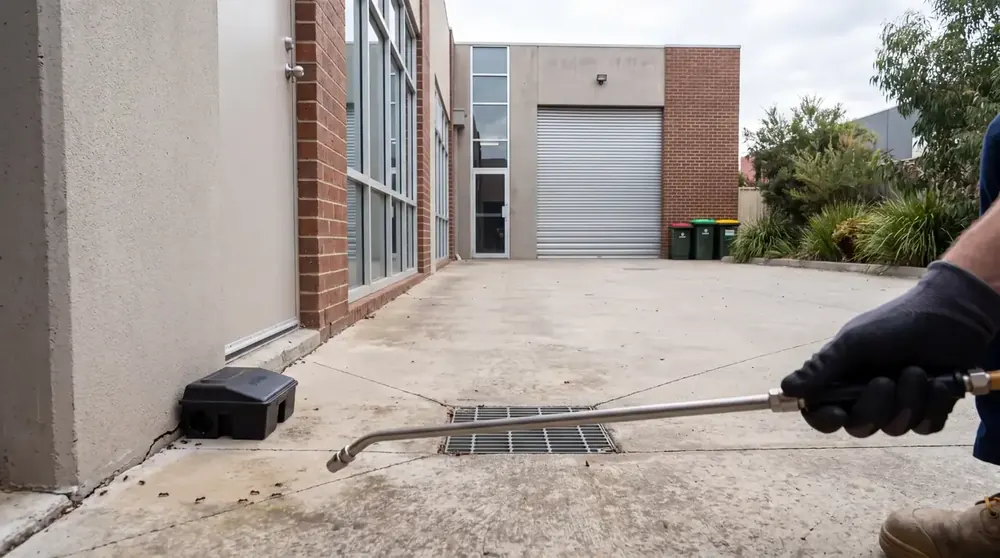
Most building-wide problems are fed from the bin room, the carpark and the service lane behind it.
Strata pest control in Melbourne is only half an insect problem. The other half is a question nobody wants to answer: whose cost is it, the lot owner's or the owners corporation's? That question stalls more apartment jobs than any treatment ever fails. A renter reports cockroaches, the manager books a unit treatment, it works for six weeks, and the cycle starts again because the population never lived in that unit in the first place.
Tim works for owners corporations, building managers and residential property managers across Melbourne, from four-pack walk-ups in Brunswick to larger blocks with basement carparks and bin rooms. Apartment buildings sit inside his commercial pest control work because they are serviced like a commercial site: scheduled visits to shared areas, access arranged across many doors, and a written record that more than one party will read.
This page covers what counts as common property and who normally pays, why a single-unit treatment keeps failing in a shared building, how a renter-reported problem should be handled, what Victorian renting law actually says about end-of-tenancy treatments, and how a portfolio of addresses runs under one operator. It is general information, not legal advice.
The boundary
What does strata pest control cover in common property?
Everything outside the lot boundaries: bin rooms and bin compounds, basement carparks, service lanes, gardens and retaining walls, letterbox banks, lift pits, risers, shared laundries and the roof space of a walk-up. Inside a lot is normally the owner's or the resident's responsibility, and the registered plan of subdivision is what actually sets the line between the two.
- Common property
- The parts of the building that belong to all lot owners together rather than to any one lot, as shown on the plan of subdivision. The owners corporation has a duty under the Owners Corporations Act 2006 to repair and maintain it, along with the fittings and services that relate to it.
- Lot
- The part of the building an individual owner holds, usually the interior of the unit. A lot owner cannot carry out works on common property themselves unless the owners corporation has expressly authorised them to act as its agent.
That duty is the reason a committee cannot simply decline a bin room problem because the complaint came from one resident. Where work is carried out wholly or substantially for the benefit of some lots rather than all of them, an owners corporation can recover the cost from those owners as a debt, which is the mechanism that settles most arguments about fairness before they start.
| Situation | Usually | What decides it |
|---|---|---|
| Rodents in the bin room and carpark | Owners corporation | The area is common property and the source is shared |
| Cockroaches in one kitchen, nowhere else | Lot owner or resident | Inspection finds no activity in the riser or neighbouring lots |
| Cockroaches in four lots on one stack | Owners corporation | A report showing movement through shared pipework or walls |
| Ants from a common garden bed | Owners corporation | The nest sits in common property even though the trail is indoors |
| Pests a renter's own habits attracted | Renter | Evidence such as stored rubbish or an untreated pet |
| Pests present when a renter moved in | Rental provider | The condition report and the date it was first raised in writing |
One more thing worth knowing before a committee signs anything. Victoria's animal cruelty regulations make it an offence to sell a glue trap, to use one, or to set one in a spot where it could catch an animal. Insect glue boards are allowed only where a cage, cover or shield keeps an animal away from the adhesive. If a contractor has left bare glue boards in your bin room or carpark, that is a problem for the owners corporation, not just for whatever gets stuck to them.
The shared wall
Why does treating one unit fail when the colony lives next door?
Because a unit is not a sealed box. Cockroaches, mice and bed bugs all move through the structure that joins the lots: plumbing stacks, electrical risers, the cavity behind kitchen joinery, the ceiling space of a walk-up and the gap where a pipe passes through a wall. Treat lot 12 on its own and the population simply sits out the residual in lot 11 and walks back.
Kitchens and bathrooms stack vertically, and the penetrations around waste pipes are rarely sealed. This is how one floor becomes four.
Party walls, bulkheads and the ceiling cavity of an older walk-up connect lots that share nothing else.
Bin rooms, carparks, laundries and garden beds feed the whole building and sit outside every lot.
So the useful thing a pest controller can hand a building is not a treatment. It is a written report that names the source, the entry point and the route, because that document is what converts a resident's complaint into a decision a committee can fund. A manager asking owners to pay for building-wide work needs something concrete to table, and "a resident keeps seeing cockroaches" is not it.
- Where the activity is, named by lot and by room, including the lots inspected that were clear.
- The route between them, such as an unsealed penetration at a waste pipe or a gap at a riser door.
- Whether the source sits in common property or inside a lot, with the reasoning stated rather than asserted.
- What the building needs: the treatment, the proofing or repair work, and the order to do them in.
Access is the other half of the problem, and it is logistical rather than technical. A stack treatment only works if the lots on it are done on the same day, which means notices to residents, a window they can plan around, and someone holding keys or meeting the technician. Tim will tell you which lots need to be in the one visit so the manager can give notice once rather than three times.
If an owners corporation will not act on a common property problem, lot owners are not without options. Where a committee does not meet its common property obligations, owners can take the matter to VCAT. Raising it in writing to the manager and asking for it to be tabled is the step that comes first, and the dated written report is what makes that request hard to ignore.
Rented lots
What do Victorian renting rules say about pests and exit treatments?
Victoria has no law requiring a paid pest or flea treatment before a renter hands back the keys, and the 30-day rule people quote does not exist. Consumer Affairs Victoria's position is that the law does not always specify who pays, so responsibility turns on cause, the condition report and when the problem was first raised in writing.
Those two myths cost managers and renters real money. The first is the exit treatment demanded as a matter of course. A rental agreement dated 29 March 2021 or later limits that demand: professional cleaning may only be required where the property has to be returned to how it was at the beginning of the tenancy. The standard is reasonably clean, with fair wear and tear allowed, not cleaner than they found it.
The "30-day rule" does not exist in Victoria. Pest industry pages circulate a fixed window after move-in, after which an infestation is said to become the renter's problem. No Victorian law sets a number of days. What decides these cases is the condition report, the cause, and the date the renter first reported it in writing, which is why reporting immediately and in writing protects everybody.
The second is the opposite error: treating a structural problem as a cleaning problem. Where pests make a property unsafe to live in, that falls under urgent repairs. Where a defect such as a hole in the roof or a faulty window frame let them in, or where they were already there when the renter moved in, Consumer Affairs Victoria puts it with the rental provider. Where a renter's own actions contributed, such as stored rubbish or an untreated pet, it sits with them. If the parties cannot agree, either can apply to VCAT.
What a manager can usefully provide is evidence rather than an argument: an inspection report that says what was found, where it came from and whether a building defect is involved. Treatments booked around a lease ending get their own detail under end of lease pest control in Melbourne, including what is worth paying for and what is simply a receipt.

Portfolios
Can one operator handle a whole portfolio of addresses?
Yes, and the gain is consistency rather than a discount. Every address gets the same inspection, the same report format and the same person, so a committee or a department head can compare one building to another and see which sites are trending the wrong way instead of reading five different contractors' paperwork.
Being honest about the limits matters more here than anywhere else on the site. Tim's Pest Control is one licensed technician, not a franchise with a call centre and a fleet. That is the reason the work is consistent, and it is also the reason a fifty-address portfolio has to be scheduled rather than dispatched. Managers who plan their common property visits ahead get the slots they want. Managers who call on the morning of an inspection sometimes do not.
Each invoice names the property, so it can be passed to the right owners corporation, owner or trust account without being unpicked first.
Same headings, same fields, so last year's report for an address can be compared with this year's in a minute.
Addresses close together are done in the same run, which keeps travel out of the cost and the day predictable.
Rodents, cockroaches, ants, bed bugs, fleas, spiders, wasps, moths and mosquitoes. Termites, possums, bees and bats are referred on.
That last line is worth reading twice if you manage older blocks. Possums in a roof space are protected wildlife and need a licensed handler, bees belong with a beekeeper, and timber pest work needs a specialist inspection rather than a pest spray. An operator who offers to deal with all of it from one van is telling you something about the rest of their work.

Getting started
How do you start on a building or a portfolio?
Begin with one inspection of the building rather than a treatment of the unit that complained. It usually costs less than two failed unit treatments, and it produces the document a committee needs before it will approve anything larger. From there the common areas go on a schedule and the lots are handled as they come up.
Worth having ready: the address and the number of lots, who the client is for billing, which lots have reported and when, what has already been treated, where the bins and carpark sit, and how access to the building and to individual lots is arranged. Those answers shape the quote, and they mean the first visit goes on the building's problem instead of its floor plan.
- Inspect the buildingCommon areas, the lots that reported, and the lots either side, above and below them.
- Report and quoteA written finding naming the source and the route, with the treatment and any proofing priced separately.
- Schedule the workNotices to residents, the affected lots done together, and common areas put on an interval that suits the building.
Every operator working in Victoria has to hold a Department of Health licence, and the register of licence holders can be searched by anyone. Tim's number is 86488, insurance is in place, and the number appears on every report, which is usually the first thing a committee secretary asks for when a contractor is proposed at a meeting.
Book a building inspection
Address, lots that have reported, and what has already been tried. Price agreed before anything starts.
Arrange an inspectionCoverage across Melbourne
Managed stock right across the metropolitan area, out to roughly 40 km from town.
See pest control in MelbourneQuestions
What managers and committees ask
Can you take on a whole portfolio?
Yes, with one condition: it has to be scheduled rather than called in on the day. Tim is one licensed technician, so a portfolio works best with common area visits planned ahead and reactive jobs fitted around them. Addresses grouped by area are done in the same run, which keeps the day predictable.
Do we get something in writing we can forward?
Yes. Every visit produces a dated record: the address, which lots and shared areas were checked, the findings, where anything was placed, and the repairs or proofing the building needs. It is written so a committee, an owner or a renter can be sent it as it stands, which is what a budget request or a VCAT file calls for.
Who pays, the owners corporation or the lot owner?
It depends on where the source is, not on who complained. Common property, including bin rooms, carparks and shared gardens, is the owners corporation's duty to maintain. A problem confined to one lot is generally the owner's or resident's. The inspection report is what settles which of the two you are dealing with.
Do you cover bins, carparks and gardens?
Those are usually the most productive areas in the whole building, so yes. Bin rooms, bin compounds, basement carparks, service lanes and garden beds are where rodent and cockroach pressure is generated, and treating units while ignoring them is why some buildings never seem to get on top of it.
How do you get into units when renters are at work?
Access is arranged by the manager or the building manager, with notice to residents and a time window they can plan around. Tim will say which lots need to be done on the same day so one notice covers them. Where a resident cannot be home, the usual arrangement is the agent meeting the technician with keys.
Is a pest treatment compulsory when a tenancy ends in Victoria?
No. Nothing in Victorian law makes an exit pest or flea treatment compulsory. For newer agreements, cleaning by a professional can only be insisted on where a property must be restored to the condition recorded when the renter moved in. A genuine pest problem is a separate matter, and worth treating properly.
Got a building where the same unit keeps reporting?
Send Tim the address, which lots have reported and what the building manager has already tried, and he will set out what the inspection needs to cover and what it costs.
Sources: Consumer Affairs Victoria on maintaining common property, Consumer Affairs Victoria on renting, and Agriculture Victoria on glue traps.