Mud wasps
Mud Wasp Nest Removal
The clay tubes on your render were built by a solitary wasp that hunts spiders and almost never stings. This page says plainly when to scrape them off yourself and when it is worth paying somebody.

Clay cells go up on warm, dry, sheltered walls. Most of them never need a treatment.
A mud wasp nest is the hard clay lump that appears on a sunny wall, a pergola rafter or a shed door frame, usually over a week or two in high summer. Up close it is a row of stubby pipes laid side by side, or one rounded blob still showing the ridges where the wasp patted each load of mud into place. Nobody is sure what to do with it, which is why the phone rings.
The honest answer is that most can be left alone or taken off with a scraper. The wasp that built it works on her own, has no colony behind her, and spends her days catching spiders. So the real questions are not about stings. They are about staining, mess, blocked weep holes and vents, and clay packed inside gear that has to keep working. Mud wasps are the third species covered by Tim's wasp nest removal across Melbourne, and the only one he regularly talks people out of booking.
What follows: what the nest is and how it is built, whether the wasps are a risk to anybody, the spots where clay genuinely causes damage, how a repeat problem is treated, and what that costs.
The nest
What is a mud wasp nest made of, and who built it?
Wet soil, carried mouthful by mouthful and shaped into sealed cells by one female working alone. Each finished cell holds an egg plus a store of paralysed spiders for the grub to eat, then gets plastered shut. There is no queen, no workers and no shared nest. A cluster of twenty tubes on one wall is simply several wasps that liked the same elevation.
The building sequence explains what people notice. She needs water, so puddles, a leaking tap, a pot saucer or a lawn edge damp from watering all put her to work nearby. She needs a spot that stays dry once the clay sets, which rules out anything rain hits. And she needs warmth, which is why north and west walls collect far more cells than the shaded side of the same house.
- Mud dauber
- The long, narrow, often orange and black wasp behind the row-of-pipes nests. The thread-waisted ones are unmistakable in flight: a slim body on a stalk-like waist, drifting low along a wall while she looks for a site.
- Potter wasp
- A smaller relative that builds a tidy round pot the size of a pea, stuck singly to a twig, a wire or a window reveal. Same habits, same lack of interest in people, neater work.
Hard, gritty, the colour of local soil, and it sticks hard to paint.
Side-by-side cylinders, a single plastered mound, or a small round jug with a neck.
Neat exit holes mean the young chewed their way out. That nest is empty and will not be reused.
A pale grub among paralysed spiders. Unpleasant, harmless, good news for your eaves.
The clay never tells you the age of the nest: a sealed lump could be last week's or three summers old. Exit holes are the giveaway, and they decide whether scraping disturbs anything living.
The honest answer
Do mud wasps sting people?
Very rarely, and almost never without being handled or trapped against skin. A solitary wasp has no colony to protect and no reason to pick a fight, so she will keep working with somebody standing a metre away. She can sting, since her venom is what paralyses spiders, but the behaviour that makes European wasps dangerous, defending an entry in numbers, simply is not there.
The practical risk sits in two places: reaching blind into a dark shed corner and closing a hand around a working wasp, or a nest built inside something you wear or hold, such as a glove left on a bench, a helmet in a carport or a brake lever on a bike parked for a fortnight. Look before you reach.
- She does not swarm, mob or chase, and she will not follow you across the yard.
- Nothing leaves a sealed cell except an adult wasp, weeks later, through its own hole.
- Pets and chickens generally ignore them, and they ignore the pets.
- A sting hurts and swells locally, the same as most insect stings.
Worth keeping in perspective: while she stocks cells she is stripping spiders out of your eaves, fences and window frames. Households that clear every clay nest on sight, then ring about webs the following autumn, are a regular pattern. If spiders are the real complaint, start with spider control.
Anybody who has reacted badly to a bee or wasp sting before should take any wasp near the house seriously, whatever the species. The Better Health Channel page about allergies to bites and stings covers the warning signs and when urgent care is needed.

Where it matters
When does a clay nest cause real damage?
When the clay blocks something that has to stay open, jams something that has to move, or stains a surface you care about. Those three cases are worth money and attention. A single old nest on a garage wall is none of them, and scraping it off on a Saturday is the whole job.
| Where it is | The problem | What it needs |
|---|---|---|
| Weep holes in brickwork | Plugs the gap that lets a cavity wall drain and breathe, which matters for damp | Clear the holes, fit weep-hole screens |
| Subfloor and wall vents | Cuts airflow under the house, where poor ventilation already causes trouble | Clear and mesh the vent face |
| Roller door housings and tracks | Clay in the guide or curtain jams the door or chews the seal | Clean out, then treat if it recurs yearly |
| Switchboards and split-system covers | Mud packed around terminals and fan housings | Seal the entry gaps, treat the surround |
| Painted render and light brick | Clay bonds to paint and leaves a brown shadow after it is knocked off | Soak, lift carefully, wash the mark |
Weep holes are the one most people have never thought about. Those small vertical gaps in the bottom course of brick exist on purpose, to let water out of the cavity and air in, and a row of them stuffed with set clay works against the wall every time it rains. Mesh or plastic covers solve that for very little money.
Staining is the other repeat complaint. The clay carries iron and organic matter out of your soil, and after a season in the sun on a pale wall it leaves a mark that outlasts the nest. Taking it off wet rather than chipping it dry is most of the difference between a clean wall and a patch job.
The work
How is a repeat mud wasp problem treated?
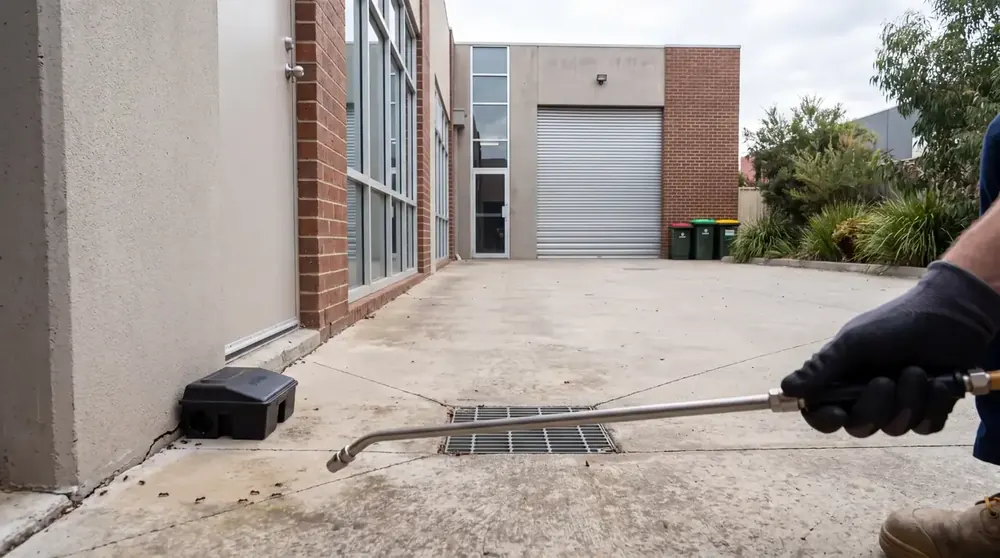
Take the nests off properly, treat the surfaces they keep choosing, then close the gaps that make the spot attractive. Removal on its own fixes this summer. The surface treatment and the screening are what change next summer, which is why Tim only quotes the job where the same elevation has been built on year after year.
- Soften and liftClay wetted until it releases rather than chipped dry, so the paint stays intact and the mark lifts with it.
- Clean the surfaceMount points washed back, since leftover smears of mud are the strongest signal to the next wasp hunting a site.
- Treat the elevationA registered residual applied to the wall, rafter or housing the wasps keep returning to, at label rate.
- Screen and closeWeep-hole covers, vent mesh and gap sealing around switch gear, so the attractive openings stop being openings.
Timing is simple compared with social wasps. There is no colony to catch at home, so the work happens whenever suits you and nothing has to wait for dusk. The only timing that counts is getting to the cells before they hatch inside a shed.
- Reduce the mud: fix a dripping tap, empty pot saucers, water early so soil is dry by afternoon.
- Close the gear: mesh over vents, a brush seal on the shed door, lids down on switchboards and pump covers.
- Clear old nests each winter rather than leaving a wall covered in last season's cells.
- Store gloves, helmets and tools in a box rather than open on a bench over summer.
Before you take a scraper to it. A sealed cell with no exit hole still holds something alive, so wear gloves and do not crack one open against your hand. Wet the clay and give it a few minutes, because dry clay shatters and grinds a streak down the wall. Stay clear of switchboards and meter boxes: a clay-packed enclosure is an electrician's job. Products Tim uses are registered with the APVMA and applied to the label.
Pricing and booking
What does mud wasp nest removal cost, and when is it worth it?
It follows how many elevations are involved, how high they sit and whether screening forms part of the work. Tim will often say on the phone that a visit is not worth your money. Where it is worth booking, the price gets agreed before anything starts, and no extras appear afterwards.
One or two old nests on a garage or fence. Tim talks you through soaking and scraping and you keep your money.
A wall, a pergola or a shed that gets rebuilt on every summer, cleaned off and treated in a single visit.
Weep holes and vents cleared and screened, equipment housings sorted, a whole building elevation treated.
Can I just scrape the nest off myself?
For most people, yes, and that is the advice you will get. Wet the clay, wait a few minutes, lift it with a plastic scraper, then wash the mark while it is damp. Gloves on, eye protection if it sits above your head, and leave anything electrical alone.
Why do they keep rebuilding in the same corner?
Because the conditions have not changed. Warmth, shelter from rain and mud within flying distance are what she selects for, and leftover clay advertises that the spot works. Removing the residue and screening the openings shifts the answer.
Do you treat mud wasps at businesses?
Yes, and that is where most of the paid work sits. Clay cells over a servery, in a cool room door frame, in roller door housings or packed into plant all fail an inspection or cost downtime, so they get cleared and treated on a schedule that suits trading hours.
Paid mud wasp work still falls inside the 3-month re-treatment guarantee: a treated elevation built on again within three months is redone at no charge. Indicative figures by pest sit on the Melbourne pest control pricing page, and the longer self-help version of all this is in Tim's guide to whether mud wasp nests are harmless.
Next step
Who should actually book a mud wasp job?
Businesses, strata buildings, anyone with clay in weep holes, vents or equipment, and households where the same wall is rebuilt on every year. Everyone else gets told how to handle it and sent on their way. That is deliberate: quoting work nobody needs is the fastest way to lose the customer when something real turns up.
Victorian operator licence 86488 belongs to Tim, the business is fully insured, and he does every job himself around Melbourne. Licence numbers are public, and the state's licensing rules for pest control operators set out how to check one before anybody comes to your address.
Send a photo first
A picture of the wall, vent or housing is usually enough for a straight answer on whether this needs a visit.
Get Tim's read on itDifferent wasp?
Open grey cells on a stalk under an eave are a social species and a different piece of work entirely.
Paper wasp nest removalThe clay on your wall was made by a spider hunter working alone. Treat it like mess, not like danger.
Found a bee cluster, a possum in the roof or termite damage in a frame instead? None of that is his trade, and the referral goes to a beekeeper, a licensed wildlife handler or a timber pest specialist. The nine pests he does treat are listed across the service pages, with the wider picture of pest control for Melbourne homes on the front page.
Questions
Mud wasp questions Tim gets asked
Do mud wasps sting?
They can, and they very seldom do. With no colony to defend there is nothing to trigger it, so people work beside them for weeks without incident. The stings that happen involve a wasp handled by accident or caught inside a glove. Anyone with a known sting allergy should still keep clear.
Can I scrape the nest off?
Usually yes. Soak it first so the clay lets go in one piece, lift it with a plastic scraper and wash the shadow off while it is wet. Wear gloves, since a sealed cell may hold a grub and spiders. Leave switchboards and meter boxes to a tradesperson.
Why do they keep coming back?
The wall has what she needs: afternoon sun, cover from rain and mud nearby. Old clay residue marks the site as proven, so new wasps settle in the same corner. Washing the mount points back, drying up standing water and screening vents is what changes the outcome.
Are the spiders inside the nest dangerous?
No. They are paralysed and stay sealed in the cell until the grub has eaten them, so breaking a nest open is unpleasant rather than risky. If the spiders themselves worry you, deal with the webs around the house instead.
Will a spray stop them building?
A residual on the surface they favour does help, and by itself it becomes a yearly expense. The lasting fix is physical: mesh on vents, covers in weep holes, seals on door housings, no free water sitting about. Treatment plus those changes stops the rebuild.
Clay cells turning up in the same spot every summer?
Send a photo of the wall, the shed or the vent and Tim will tell you whether this is a scraper-and-bucket job or something worth booking.
Sources: Better Health Channel on allergies to bites and stings, Victorian pest control licensing and the APVMA.