Kitchen guide
How to Get Rid of Ants in the Kitchen
The kitchen is the one room where you cannot treat ants the way you would treat a shed. This guide covers the bench, the kickboard void, the dishwasher, the bin and the pet bowl, and what to wipe versus what to leave alone.

The gap where the waste pipe passes through the cabinet base is the most missed entry point in the room.
People start searching how to get rid of ants in kitchen cupboards at about nine at night, usually after finding a line of them crossing the sink for the third evening in a row. The kitchen is where almost every household ant problem gets noticed, because it holds the three things a colony sends scouts out for: sugar, grease and water.
It is also the hardest room to treat badly. Food gets prepared here, children lean on the cabinetry, the dog eats off the floor, and half the surfaces get wiped every single day. That combination rules out most of what people reach for first, and it rewards a slower approach that almost nobody tries.
What follows is the kitchen-specific version of the method, written from jobs across Melbourne. It sits alongside Tim's other pest control guides, and it assumes you have already read nothing and want the short, honest version.
The attraction
Why do ants head straight for the kitchen?
Scouts find a reward within a few minutes in most kitchens, and once one scout reports back the rest follow the scent she laid on the way home. The reward is rarely an open bag of sugar. It is the film of grease behind the cooktop, the drip under the fruit bowl, the crumb layer beneath the toaster or simply a wet sink at midnight.
Moisture matters more than food in a Melbourne summer. Through a run of dry January days, ground nests under paths and garden beds dry out and foraging switches towards water, so kitchens that have never had a trail suddenly get one. The opposite also happens: after heavy rain soaks a nest, whole columns move indoors through the laundry or the back door within a day or two.
Then there is the cabinetry itself, which is why kitchens hold ants in a way that a tiled bathroom does not.
- Kickboard void
- The sealed cavity under base cabinets, behind the removable plinth at floor level. It is dark, dry, warm from the dishwasher and oven, and it runs the full length of the cabinetry, which makes it the most common indoor nest site in a Melbourne kitchen.
Two other spots reward a look with a torch. The cavity around a dishwasher stays warm and slightly damp, and its door seal collects a sour film of starch. Behind the fridge, the compressor coils sit warm and dusty, and a trail up the back panel goes unnoticed for weeks.
Ants inside a power point or an appliance are a different problem. Victorian health guidance records that Singapore ants are drawn to plastics in electrical equipment, nest in power sockets and chew wiring, and have been responsible for electrical fires. If you are seeing ants coming out of a switch, a socket or an appliance housing, stop baiting around it and get it looked at properly.
None of this means the room is dirty. One weeping tap washer and a pot plant pushed against the wall outside is enough.
Tracing it
Where is the trail coming in, and how do you find it?
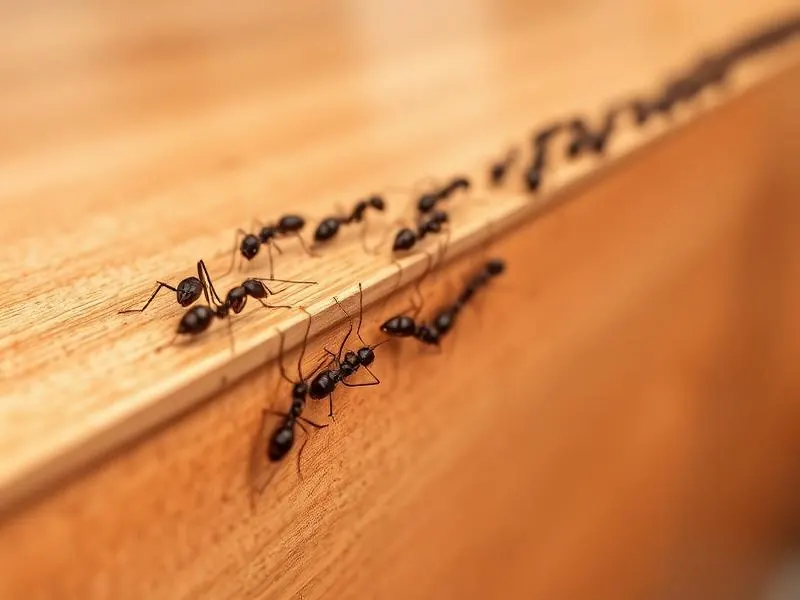
Watch an active line for ten minutes at dusk and follow it in the direction the ants are travelling empty-handed, because that is the way home. Workers heading out move faster and carry nothing; workers heading back move slower, often with a crumb held up. The line almost always ends at a joint, not a hole: the end of a bench, an architrave, a pipe collar or the gap above a kickboard.
Do this before you clean anything, because wiping the bench scatters the line and loses the only map you had. A phone torch held almost flat against the floor throws long shadows and makes a thin trail obvious in a way overhead light never does.
| Where to look | What you will see | What it means |
|---|---|---|
| Under the sink | A line along the waste pipe or the mixer tail, often with a damp patch | They are coming through the pipe collar from the wall or subfloor, and there may be a slow leak |
| Kickboard edge | Ants appearing and vanishing at floor level with no visible hole | The void under the cabinets is being used as a runway, and possibly as a nest |
| End of the bench | A trail down the silicone joint where the benchtop meets the wall | A gap behind the splashback connects to the wall cavity above |
| Window above the bench | Ants on the reveal, the sill or the flyscreen frame | An outside nest in a bed or a pot, with a shrub or climber acting as a bridge |
| Dishwasher cavity | Ants on the door seal, under the base plate or at the hose penetration | Warmth and starch residue, usually reached from the kickboard void |
Direction tells you where to put the bait. If the line runs outside, treat it at the threshold and keep going into the garden bed or paving on that side. If it disappears into the cabinetry and never leaves the room, you are probably dealing with a satellite nest in the void, and the work happens entirely inside.
One more reading: press a fingertip on a worker and smell it. Black house ants give off a strong sharp odour when crushed, which separates them from the larger banded ants that forage after dark.
Placement
How to get rid of ants in kitchen cupboards without putting bait near food?
Keep every bait inside an enclosed space the ants can reach and you cannot see: the hinge recess, the back corner of a cupboard carcass, the underside of a shelf, or the kickboard void through its gap at the floor. A bait on an open bench or a plate is both less effective and against the point of the label, which sets out where a product may be applied.
Gel is the right form here, in four or five pinhead spots rather than one blob, each on the hard edge of the run they already use. Size matters: a big spot skins over and gets abandoned, while small ones stay soft long enough to be emptied.
- Clear a path, not the trailMove food and utensils out of the cupboard you are treating. Leave the trail itself alone.
- Place small and lowPinhead spots in hinge recesses, cupboard back corners and along the kickboard gap. Nothing on a bench or a food surface.
- Match the tasteSweet gel for ants on the sugar and fruit. An oily or protein bait for ants working the pet bowl, the grill or the bin.
- Hold off for a weekNo surface spray, no bleach on the line, no mopping the kickboard. Check the spots each morning and top up the ones emptied.
The food-surface question has a clean answer: there is no safe way to put bait on a bench, a chopping board, a drying rack or inside a food container, so do not try to engineer one. If the only activity is on the bench, bait the cupboard beneath it and the kickboard below that, then let the trail take the product down to the nest for you.
Pets change the plan rather than cancel it. A dog that licks anything new gets enclosed stations only, behind a closed cupboard door or in the kickboard void where a snout cannot follow. Anything used in a food area carries a registration number, and the national pesticide regulator sets the label conditions that decide the rate and the rooms.
If you are mixing your own: make it far weaker than looks sensible. The homemade borax baits that fail are the strong ones, because a worker that dies at the bait never carries a share of it home to the brood. Feeding should continue for two or three days.

Honest split
Which cleaning helps, and which wipes the treatment away?
Removing what fed the trail helps. Scrubbing the surfaces where the product sits undoes the job. The split runs by location rather than by effort: sealed storage, the bin lid, the pet bowl and the grease film are all worth attacking hard, while the kickboard line, the hinge recesses and the cupboard back corners get left completely alone for about a week.
Hot soapy water on the splashback and the strip behind the cooktop removes the fat film that keeps a trail interested. Do not run a cloth along the silicone joint at the back of the bench if bait sits in the cupboard below it.
The underside of a bin lid holds a sticky film that a new liner does nothing about. Wash the lid and the rim, keep it closed, and move the bin away from the cabinetry while the baiting runs.
Pull the rubber door seal open and clean the fold, where starch collects. Avoid mopping or steaming the floor at the front of the machine, because that is the kickboard gap where the bait is working.
Pick bowls up after the last feed, wash them, and dry the floor underneath. A standing water bowl in a dry spell is often the one reason a trail keeps running, and a protein feeder picks the bowl over your bait every time.
Sugar, honey, flour, cereal, biscuits and dry pet food move into glass or clip-lid containers. A folded packet with a peg is not sealed. Wipe the rim of the honey jar, the one thing nearly everyone forgets.
There is a second reason to hold off on the heavy mopping. Disinfectant, bleach and steam all destroy the pheromone trail, and that trail is what carries the next thirty workers to the bait you placed. Erasing it slows the result for no benefit.
For about a week, your kitchen needs two rules at once: spotless where food sits, untouched where the ants walk.
Once activity has stopped for a few days, clean everything properly, treated edges included, then close the gaps you found. Silicone at the end of the bench, a collar around the waste pipe and a trim of the shrub touching the wall outside do more for next summer than anything in a bottle.
The limit
When does kitchen baiting stop working?
Four signs mean the retail route has run out: bait refused after you have tried both a sweet and a protein type, a fresh trail appearing on a different wall, ants in the dishwasher wiring or a power point, and a soft or swollen cupboard base. None of those are solved by another jar of gel.
- Bait ignored both ways. The species is not baiting readily, or something better is still available in the room.
- A second trail starts. Often a budding species splitting under pressure, which needs the whole run of cabinetry and the outside treated together.
- Ants in the appliance or socket. An electrical risk and a nest you cannot safely open.
- Swollen cabinet base or a musty smell. There is water in the carcass, and damp timber attracts a different ant again.
At that point the useful thing is not a stronger product but access. A technician can dust the kickboard void and the cavity behind the splashback through gaps that already exist, and treat the garden side of the same wall in one visit so the supply stops.
Small sugar-feeding ants in cabinetry are the most common version of this job in Melbourne, and the page on sugar ant and black house ant control sets out how the visit runs, what it costs and what you need to do beforehand. Covered work is backed for three months: should those ants turn up again where he treated, the return visit costs nothing. His Victorian licence number is 86488, which you can look up on the public register before booking.
If you would rather just get it dealt with, book a pest control treatment with a photo of the trail and your suburb attached. Leave one line running and spray nothing for two days beforehand: a live trail is the quickest route to a nest.
Questions
Kitchen ant questions Tim gets asked
Is ant bait safe to use near food?
It is safe where the label allows it, and the label never allows it on a food surface. Keep gel inside hinge recesses, cupboard back corners and the kickboard void, with food and utensils moved out of the cupboard being treated. If you cannot place it out of sight and out of reach, do not place it.
Why is it always the kitchen and never the rest of the house?
Because the reward and the shelter sit in the same place. Grease, sugar and standing water are all in this one room, and the cabinetry gives a colony a dark, dry, warm void to run through at floor level. Bedrooms offer one of those things at most.
Should I spray instead of baiting in a kitchen?
No. A knockdown spray clears the visible line and leaves the colony producing replacements, and most retail products repel, so the ants open a second route through the cabinetry where you cannot see them. In a food area it also puts residue where you least want it.
Do I need to empty the cupboards first?
Only the cupboard you are treating, and only the shelf nearest the bait. Food, plates and utensils come out, the bait goes into the back corner or the hinge recess, and the door closes. There is no need to strip the whole kitchen onto the dining table.
There are ants in my dishwasher. Is that a problem?
It is a sign rather than a fault. The cavity is warm, the door seal holds a starchy film, and the machine sits against the kickboard void, so ants reach it easily. Clean the seal fold, dry the base plate, and treat the void rather than the appliance itself.
Do I have to throw out food the ants got into?
Discard anything they have been inside, such as an open packet of sugar, cereal or biscuits, because you cannot clean a product you eat. Sealed jars, tins and anything the ants only walked across are fine once washed. Then decant the rest so the next scout finds nothing.
Ants back on the bench a week after baiting?
Send a photo of the trail and your suburb, and Tim will name the species and set the price before anything is booked.
Reviewed October 2026 by Tim, licensed pest control operator (Victorian licence No. 86488). Product registration and label conditions: APVMA. What to ask a pest control operator before work starts: Better Health Channel.