Clothes moths
Clothes Moth Control: How to Get Rid of Clothes Moths
Holes in a wool coat are last season's feeding, not this morning's moth. Tim finds what the grubs are living on and treats that.

Robe bases, drawers and storage boxes get searched before anything is treated.
Most people start looking up how to get rid of clothes moths in April, when a storage box comes down from the top of the robe and the good jumper has three holes in the shoulder. The timing is cruel and also misleading. Whatever did it has very likely finished feeding and gone, and the small straw gold moth you flicked off the robe door could not have eaten a thread of that jumper if it tried.
Tim treats this pest in houses, units and rentals across the city, and the work sits beside the pantry and carpet jobs under his Melbourne moth control service. He attends every job himself, which counts here, because the outcome rides on how carefully someone searches drawers, boxes, robe bases and stored bedding.
What follows: which stage does the chewing, the fabrics it can and cannot digest, what a robe treatment involves, and an honest rating of washing, freezing, dry cleaning, moth balls and cedar.
Life cycle
Why is it the grubs and not the moths that damage clothes?
Only the grub stage can chew fabric. The adult has no feeding mouthparts and lives a fortnight or so on nothing at all. A female glues eggs straight onto wool or silk, the grubs hatch and graze the fibre for anything between six weeks and most of a year, then seal into a cocoon and emerge ready to breed.
- Webbing clothes moth
- The usual offender here. Its grub lays a loose silk sheet over whatever it eats, so the surface looks faintly glazed and the feeding stays in one patch.
- Case-bearing clothes moth
- Less often seen. This grub builds a small portable tube from the fibres it has eaten and tows it along, so holes end up scattered and you find discarded cases.
| Stage | What it does | What you notice |
|---|---|---|
| Egg | Stuck to a fibre deep in a fold or a seam, too small to pick out by eye | Nothing whatsoever |
| Grub | Grazes fibre and spins silk under collars, inside cuffs and along seam allowances | Holes, a faint glaze, gritty specks in the drawer |
| Cocoon | Spun onto a robe panel, a rail bracket or the carpet border, not onto the garment | A small ribbed case, the shade of whatever was eaten |
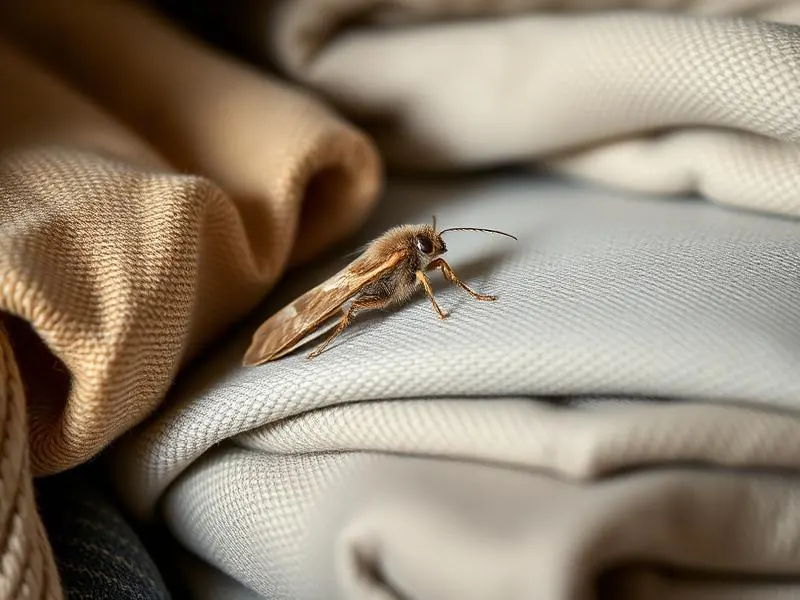
| Adult | Breeds and lays. It shuns light and would rather scuttle than fly a room | A pale moth about 7mm long, still, on a robe door |
Why autumn is the busy season: these calls cluster through March, April and May, as coats, blankets and knitwear come out for a Melbourne winter. The eating happened over the warm months inside a robe nobody opened between the spring carnival and Easter, which is exactly the quiet, dark run the grubs need.
The menu
Which fabrics do clothes moth grubs feed on?
Anything grown on an animal is edible to them: wool, merino, lambswool, cashmere, mohair, alpaca, felt, fur, feather and silk, plus any blend holding a share of those. The grubs break down keratin, the tough protein in hair, and no cotton, linen, viscose or polyester thread contains it. That is the whole dividing line.
Soiling moves the line. A grub will cut through polyester lining or a cotton shirt put away carrying sweat, milk or a food spill, because the residue is the meal and the cloth is in the road. Damage lands on the one garment that went into storage unwashed.
Fine open-structured hair. Grubs settle into the pile and feed without reaching the outer face, so damage shows up late.
Dense wool with no weave to interrupt feeding. Old blankets, hat felt, slippers and sheepskin liners are regular finds in a garage.
Suiting, shoulder padding, scarves and linings all qualify. Damage hides under the collar and in the armhole while the coat hangs.
A 20 per cent wool blend feeds them slowly. Clean cotton and clean synthetics do not, until a stain gives a reason to chew.
Easy things to miss: feather pillows and down jackets, the wool runner on the robe floor, piano felts, a sheepskin seat cover in the shed, keepsakes wrapped in a box, and wool batts above a ceiling.
Careful with keepsakes: a boxed heirloom garment is the worst thing to guess with. Hot water, a hot dryer and a freezer each carry a risk with aged silk, beading or a dry-clean-only label, so ask a textile cleaner first. Losing the item to a bad decision beats the holes for regret.
The treatment
How to get rid of clothes moths from the wardrobe itself?
Empty it, vacuum it hard, then treat the bare shell. Garments are handled separately by laundering, dry cleaning or cold, and nothing goes onto clothing. What gets treated is the timber and the junctions the cocoons are spun onto: panel joins, the floor border, rail brackets, drawer runners and the carpet strip the hanging clothes keep dark.
- Clear it outEverything comes out so the inside can be seen. Items with holes, glazing or cases go into sealed bags away from the clean pile.
- Vacuum firstA crevice tool through every corner, groove and screw hole lifts out eggs, cases and debris that no product reaches well.
- Treat the shellProduct goes into the cracks and junctions of the empty robe and along the floor border, to the registered label.
- Reload and watchOnly clean or treated items go back, and the same spots get rechecked, because thick wool can hide a grub through one visit.
Where the cocoons sit decides whether a job holds. Grubs crawl away from their food to pupate, so they end up in the angle between the robe base and the back panel, behind a loose skirting, under a built-in drawer lip, inside a hollow rail bracket, and down in the carpet border that hanging garments shade all year. Treat the clothes, miss those places, and a second generation walks out in spring.
An empty robe can be treated properly in half an hour. A full one cannot be treated properly at all.
Everything applied holds an APVMA registration, and the label approved by the national regulator sets the rate, the surfaces it may touch and how long before the room is used again. If there is a baby in that room, or someone with asthma, say so when you book.

Garment care
Should you wash, freeze or dry clean the affected clothes?
All three kill eggs and grubs on an item, so the care label decides which you use. Wash hot where the fabric allows, freeze what cannot take water or heat, and send structured or delicate pieces to a dry cleaner. The holes stay. The aim is to stop that garment being live food before it rejoins the rest.
Hot wash and dryer
Simplest for washable knitwear and bedding. Use the hottest setting the label permits, then a hot tumble dry. A cold cycle leaves eggs sitting in the seams.
The freezer
Bag the item, press the air out and give it several days in a deep freezer. A fridge freezer opened daily works more slowly, so leave it longer.
Dry cleaning
Right for suits, coats and tailoring that cannot be wetted. Tell the cleaner what you found, and bring the piece home in the plastic.
Storage is where the result is won. Grubs cannot reach what they cannot get into, so aim for a genuinely sealed container rather than a good looking one. Cardboard, a garment bag with a short zip and a tub with a warped lid all let a female walk in and lay.
- Store clean only. One worn jumper feeds whatever hatches in the tub with it.
- Hard tubs with a gasket, or vacuum bags you have checked for leaks, beat fabric bags.
- Open the box once over summer. Two minutes in January saves the April discovery.
The oil puts some adults off while the scent is strong, which lasts months at best. It kills neither eggs nor grubs.
They act by vapour, so an open robe never holds enough. The smell transfers to everything and they must stay clear of children.
Pleasant in a clean drawer and worth nothing against grubs in the fibre. Treat them as scent rather than pest control.
Sequence matters more than products: garments first, then the empty robe, then the storage. Tim's guide to clearing clothes moths out of a wardrobe step by step sets out the full order if you want a go on your own first.
Pricing
What moves the price of a clothes moth job?
How many rooms are involved, how much storage has to be opened, and how much preparation is already done. One robe in one bedroom is a short visit. A house where woollens, bedding and boxes sit across three rooms and a garage is a different job, and Tim says which one you have before quoting, not after.
A single built-in or freestanding robe, emptied by you beforehand, searched, vacuumed and treated in one visit.
A robe or two, the drawers, the boxes in the bed base and the carpet strip beneath, with a check visit after.
Woollens and stored textiles across a house, or a source in a shed that keeps resupplying the bedrooms.
A household that has already laundered the knitwear and cleared the shelves gets a shorter, better visit than one where a technician works around full cupboards. If you manage only one piece of preparation, empty the robe the holes were in.
Whatever price you approve is what you are invoiced, since it is agreed before any work starts and nothing is added on later. Covered clothes moth work carries a 3-month re-treatment guarantee: should this pest reappear within three months in a spot that was treated, the return visit is free. Which terms apply depends on the treatment, and that gets explained up front. Indicative figures for all nine pests Tim handles sit on the guide to pest control costs.
What a very cheap quote leaves out: the search. Spraying a robe with the clothes still in it takes five minutes and finds nothing, and the cocoons in the floor border and the rail bracket come through it untouched. The real cost of that visit is the second one next autumn.
Next step
What should you tell Tim when you book?
Where the damage is, what fibre it is in, and how many rooms hold wool. From those three answers Tim can usually say whether this is a clothes moth, a carpet feeder or something else, what to prepare before the visit, and what the treatment costs. Photos of the holes and the inside of the robe help.
- Bring the evidence. A damaged garment, a shed case or a photo in good light settles the species faster than a description.
- Say what you have sprayed. If an aerosol has been used in there, the picture changes and it is better known beforehand.
- Mention the household. Babies, pregnancy, asthma, cats, dogs, birds and fish tanks all shape where product can go.
- Flag stored textiles. Boxes in a shed, garage or roof space are a frequent source and easy to leave out.
Get the robe sorted
Tell Tim what has been chewed and he will name the likely insect and set a price before anything is booked in.
Ask Tim for a quoteSeen other pests too?
Silverfish, carpet beetles and spiders like the same quiet corners, and a single booking can take in more than one of them.
Browse every treatment Tim offersHis Victorian licence number is 86488, checkable on the public register kept by the Department of Health, and he is fully insured for this work. Jobs run through Melbourne and its surrounding suburbs, broadly a 40 km radius of town. Four pests are outside his trade and get referred on: termites, possums, bees and bats.
Questions
Clothes moth questions worth asking
Does cedar actually work against clothes moths?
Only as a mild deterrent, and only while the wood still smells. Cedar oil puts some egg-laying adults off a space, but it does nothing to eggs or grubs already in the fibre. Sanding the block lightly brings the scent back for a while. Use it in a robe you have already cleared.
Should I freeze my clothes to kill clothes moths?
Freezing suits items that cannot be washed hot. Seal the garment in a bag, squeeze the air out and leave it in a deep freezer for several days rather than overnight. Let it come back to room temperature inside the bag, so condensation forms on the plastic instead of the wool.
Will clothes moths eat synthetic fabrics?
Not the fibre itself, because polyester, nylon and acrylic hold no keratin to digest. They will chew a synthetic soiled with sweat, food or body oil, and they will cut through a lining to reach wool behind it. A clean synthetic stored on its own is safe.
Do I have to throw out the damaged clothes?
Usually not. Once an item is washed hot, frozen or dry cleaned it stops being food, and an alterations shop can often close small holes in a knit. What should go are pieces eaten past wearing, since they keep feeding the next generation.
How long before the moths stop appearing?
Expect the odd adult for a week or two while grubs already sealed in cocoons finish and come out. The count should fall away steadily from there. Fresh holes in something that was clean when it went back means a second source is still feeding.
Found holes in the woollens?
Photograph the damage and the inside of the robe, send it through with your suburb, and you will hear back on what you are dealing with and what the visit costs before anything is locked in.
Sources: APVMA pesticide registration, the Better Health Channel on pest control in the home and Victorian pest control licensing.