
Wardrobe guide
How to Get Rid of Clothes Moths
A salvage and storage playbook: what saves a garment, what the scented products can and cannot do, and the end of season routine that stops this happening twice.
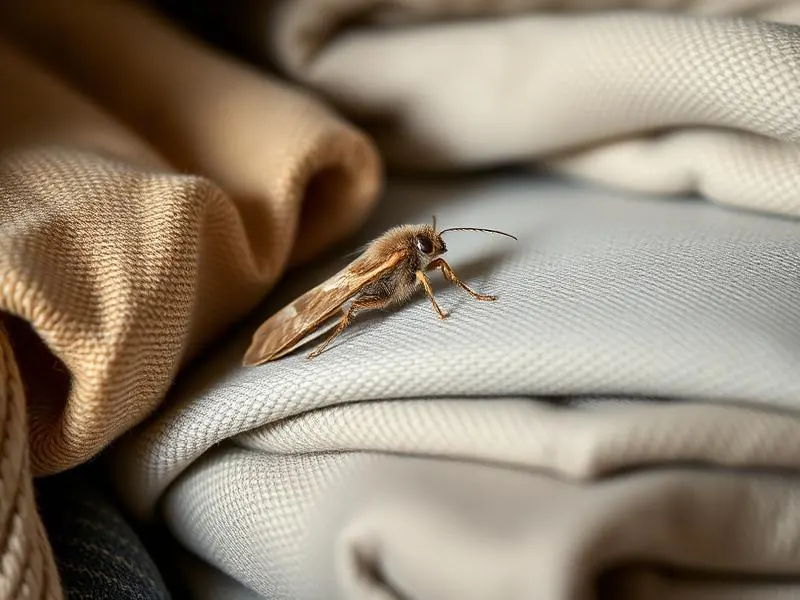
It has no working mouthparts. Whatever ruined the jumper finished months ago.
The search for how to get rid of clothes moths usually begins on the day a good coat comes out and there are three holes in the shoulder. By then the feeding is history, the insect responsible has usually gone, and the small pale moth sitting on the robe door is not the culprit. It has no working mouthparts and could not chew a thread if its life depended on it.
This guide is about recovery and prevention rather than identification. It covers which garments can be saved and exactly how, the end of season routine that keeps this from repeating, an honest account of what cedar, lavender and mothballs can and cannot do, and what has to happen to the robe itself. For which moth you actually have, start with Tim's index of household pest guides and work from the damage.
The good news arrives early: very little usually needs throwing out. The holes are permanent and the item stops being food once it has been treated properly, which is a different outcome from the one most people expect.
The culprit
Why is the damage already finished by the time you see it?
Because the feeding stage is a grub that hatched from an egg laid weeks or months before, grazed the fibre in a dark fold, then sealed itself away to become the moth you found. By the time an adult is visible the harm to that garment is done, and your job is to stop the next generation rather than to chase the one in front of you.
That lag explains the timing of almost every call. In Melbourne these discoveries cluster in the first cold weeks, when storage boxes come down and winter clothing gets unpacked. The eating happened quietly through the warm months inside a robe that nobody opened between one season and the next.
- Keratin
- The tough protein in animal hair, feather and skin. It is the only thing these grubs can digest, which is why wool, cashmere, alpaca, mohair, felt, fur, feather and silk are at risk and cotton, linen and polyester are not.
Stains move that boundary, which catches people out every year. Where a cotton shirt or a polyester lining holds dried sweat, milk or spilled food, a grub will chew straight through the cloth to reach what is on it. That is why harm lands so reliably on whichever item went into storage unwashed.
- Hidden faces first. Under a collar, inside a cuff, along a seam allowance and on the back of a folded jumper, where it is dark and still.
- Grit in the drawer. Fine sandy specks that look like sawdust are droppings, and they are often the first sign anyone notices.
- A faint glaze. Thin silk laid over the surface where a grub has been grazing, sometimes the same colour as the fibre it ate.
- Nothing on what you wear. Items in regular rotation are handled, aired and washed, which is enough to keep them out of trouble.
Salvage
How to get rid of clothes moths without losing the garment
Heat, cold or a dry clean will all do it, and the choice depends on the care label rather than the damage. Wash as hot as the garment allows and follow with a hot tumble dry, hand anything that cannot be wet to a dry cleaner, or bag the small pieces and give them the best part of a week in a freezer running properly cold. Holes are permanent. The insects are not.
Work through the whole affected group rather than the obviously damaged items only, because eggs and grubs are far smaller than the holes and sit on neighbouring garments as readily as on the ruined one.
| Item | Best method | Watch out for |
|---|---|---|
| Machine washable wool | Hottest wash the label allows, then a hot tumble | Shrinkage, so follow the label rather than guessing |
| Cashmere and fine knitwear | Sealed in a bag and frozen for several days | Let it return to room temperature before unsealing |
| Suits, coats and tailoring | Professional dry cleaning | Say why you are bringing it in, so the bagging is handled properly |
| Blankets and throws | Hot wash and a long hot dry | Capacity, since a half washed blanket is a treated blanket |
| Sheepskin, felt and fur | Specialist cleaning or freezing | Water ruins most of these, so do not improvise |
| Feather pillows and down | Hot dryer cycle where the item allows it | These are regularly forgotten and are a genuine food source |
Freezing rewards care. Squeeze the air out, close the bag properly, and allow days rather than one night, since a thick folded garment chills slowly through its middle. Take it out, let it come back to room temperature while still sealed, and only then open it, or condensation forms in the fibres.
Put treated items somewhere else: clean clothing returned to a robe that has not been dealt with simply starts again. Bag the treated group and keep it out of that room until the space itself has been emptied, vacuumed and wiped.
Honest ratings
Do cedar blocks, lavender and mothballs do anything?
Cedar and lavender discourage mildly, fade as their scent fades, and kill nothing that has already hatched in the fibre. Mothballs need a closed box holding enough vapour to matter, and an ordinary robe never gets there. They also bring safety considerations with them. None of the three ends an active problem.
The useful way to think about all of this is the difference between discouraging an adult from laying and killing something that is already feeding. Scented products attempt the first, badly. Nothing in that category achieves the second.
While the oil in it is fresh, cedar puts an egg laying female off a little, and the benefit disappears along with the smell. Sanding the block revives it for a while. Keep it for an already clean robe instead of treating it as a cure.
The same story with less behind it. Sachets smell good and give people something to do. They will not stop a grub that hatched on the garment it is sitting beside.
Everything depends on vapour building up, so the item has to be a properly closed box or a zipped garment bag. Open shelving loses it. Whatever is stored alongside picks up the odour and holds it for months.
Strong plant oils repel at best. Some are genuinely hazardous in concentrated form, and pennyroyal in particular should be left alone because of the health warnings attached to it.
Mothballs are not a nostalgia item. Keep them somewhere no pet or young child can get at, use them in a sealed container exactly as the packet directs, and never tip them loose into a drawer. If the choice is between mothballs in an open robe and properly cleaned clothing in a sealed box, the second one wins on every count.
There is one storage product that genuinely helps and gets overlooked: a good quality sealed container. Clean items in a hard box with a gasket, or in a zipped bag with no holes, are beyond reach regardless of what is happening in the rest of the room. That is a physical barrier rather than a smell, which is why it works.
The space itself
What has to happen to the wardrobe?
Empty it completely, vacuum every surface including the floor, the rails, the back corners and the carpet beneath it, then wipe it out and allow it to dry fully before a single item returns. Cocoons are spun onto the robe panels, the rail brackets and the carpet border rather than onto the clothing, so the garments can be perfect and the space still carrying the next generation.
This is the step that decides whether the laundry work holds. It is also the step most households skip, because emptying a wardrobe properly takes an afternoon and nobody enjoys it.
- Take everything outHanging items, folded items, shoes, boxes, bags, and whatever is sitting on the top shelf.
- Vacuum the carcassCrevice tool along the joins, the rail brackets, the back corners, the shelf lips and the floor of the robe.
- Do the room tooThe carpet border under and in front of the robe, under the bed, and inside any storage drawer base.
- Restock cleanOnly laundered or treated items go back, with the rest sealed in boxes until the room is settled.
Widen the search while the room is open. The items that quietly feed a wardrobe problem are almost never hanging in it: a sheepskin rolled in the shed, a wool runner on the robe floor, keepsakes wrapped in a box, a felt hat, old blankets in a garage, and batts of wool insulation above a ceiling hatch. If moths keep returning to a clean robe, one of those is still active somewhere nearby.
Renters have one extra thing to do, and it is worth five minutes. Photograph the damage with a date, note it in writing to the rental provider, and check the entry condition report. The standard a renter in this state has to meet is reasonable cleanliness and the same state of repair as at the start, with fair wear and tear allowed, and any bond claim must come with evidence that sits consistently with the entry report. Damage to carpet or fittings that was already there is not yours to wear.

The limit
When does a wardrobe job need a technician?
When two or more rooms are affected, when the robe is built in with a base that cannot be opened, when the problem has returned after a full strip and launder, or when the textiles at stake are valuable enough that another failed attempt is the expensive option. Those are the four that do not resolve with a second weekend.
More than one room
Two robes active at once, or a robe and a hallway, usually means a shared source such as carpet, underlay or stored textiles feeding both.
Fixed joinery
A built-in robe with a sealed base, a void behind a mirrored door or a platform bed with an enclosed frame cannot be emptied or vacuumed properly.
Items worth protecting
Heirloom knitwear, tailoring, costume, rugs or stock. The cost of another failed attempt is what makes the decision here, not the size of the insect.
What a proper visit gives you is a search before any product comes out, the species named rather than assumed, treatment aimed at the robe carcass, the carpet border and the harbourage instead of at your clothing, a written note of where the source was found, and clear instructions about what to launder before the space is restocked. If nobody tells you where it was feeding, you cannot stop it happening again, which makes that note the most valuable part of the job.
That work is clothes moth control, which sets out how a robe is handled, what gets treated and what has to be laundered first. Tim does every visit himself under Victorian licence 86488, the business is fully insured, and there is a three month guarantee over the rooms treated, so the same insect showing up again during those months brings him back for free. Send through a quote request with a photo of the damage attached.
Questions
Questions about moths in a wardrobe
Does cedar keep clothes moths away?
Only mildly, and only while the scent lasts. Fresh cedar oil discourages an adult from settling to lay, which is not the same as killing anything. It has no effect on eggs or grubs already in a garment, so it belongs in a wardrobe that has been emptied and cleaned rather than one with an active problem.
Does freezing clothes actually work?
Yes, provided it is done properly. Bag the item with the air squeezed out and give the freezer the best part of a week rather than one night, because thick folded wool chills slowly through its middle. Allow it to reach room temperature inside the bag before opening it.
Are my synthetic clothes safe?
Clean synthetics and clean cotton are safe, because the grubs can only digest the protein in animal fibre. A synthetic carrying sweat, milk or food residue is a different matter, since the grub eats the residue and cuts through the cloth to reach it. Store everything washed and that risk disappears.
Should I use mothballs?
Only inside a container sealed well enough to hold the vapour, because that is the only situation where they do anything. An open wardrobe lets it disperse. They transfer their smell to everything nearby and need keeping well away from children and pets. Sealed storage of clean items usually beats them outright.
Why did it come back after I washed everything?
Because the cocoons were never on the clothes. Grubs leave the fabric to pupate on the robe panels, the rail brackets, the skirting or the carpet underneath, so laundering the contents and returning them to an untouched space restarts the cycle. The robe itself has to be emptied, vacuumed and wiped.
Can I just throw out the damaged items?
You can, and on its own it rarely ends it. The ruined jumper is the evidence rather than the cause, and eggs or grubs will be on neighbouring items and in the space around them. Treat the whole affected group, deal with the wardrobe, and keep only what you want to keep.
Found holes in more than one thing?
Tell Tim which items, which room and where they were stored, and he will say whether this is a laundry weekend or a treatment.
Reviewed October 2026 by Tim, licensed pest control operator (Victorian licence No. 86488). Choosing the least toxic product for an identified pest: Better Health Channel. Renting, bonds and condition reports: Consumer Affairs Victoria.