Biosecurity guide
Fire Ants: What Melbourne Residents Need to Know
Red imported fire ants are a declared pest insect that Australia is still fighting in Queensland. Here is the honest position for Victoria, how to recognise the real thing, and who to tell if you ever do.

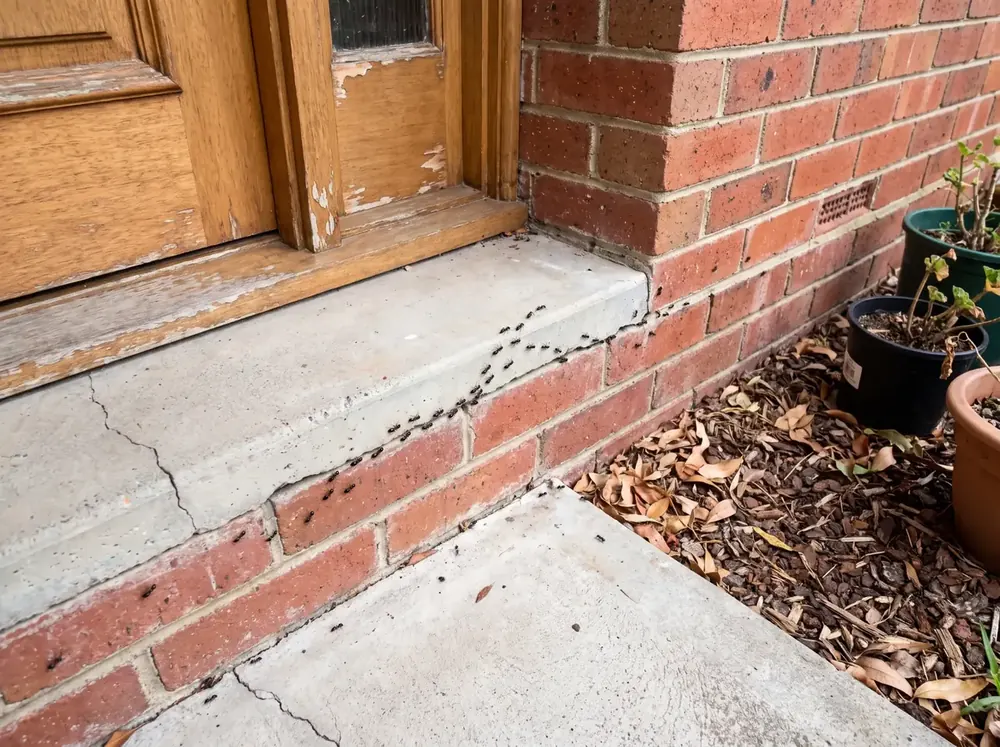
Loose soil beside a wall means an ant colony. In this state it belongs to a local species.
Red imported fire ants are a declared pest insect, and Australia is still spending serious public money trying to wipe them out in Queensland. If you arrived here after searching for what a fire ant nest looks like, the short version is reassuring: this species is not established in Victoria, so the mound in your lawn is almost certainly one of the ants that have always lived here.
That does not make the question silly. Material moves between states every day, people do see mounds they cannot explain, and the one thing a biosecurity program depends on is the public raising a hand early. So this page is written two ways at once. It explains what the real insect looks like and exactly who to tell, and it also sorts out the much likelier local candidates so you are not left guessing. It sits alongside Tim's other guides to household pests, one for each insect he is licensed to treat around this city.
Nothing on this page asks you to buy anything. If what you have turns out to be a local species, the last section tells you which one and what to do about it.
The status
Are fire ants established in Victoria?
No. The Australian infestation of red imported fire ants is centred on south east Queensland, where a national eradication program has been running for years, and Agriculture Victoria lists the insect among the exotic pests it asks the public to report rather than among the pests Victorians live with. That is the practical difference. Here it is a biosecurity matter, not a backyard treatment.
The reason the department wants to hear about sightings is simple. Eradication only stays possible while the number of separate infestations stays small, and every new one found early is cheaper to deal with than one found two summers later. The public are the only people who can watch every suburb at once, which is why reporting is the behaviour that gets asked for.
- Exotic pest insect
- A species that does not belong to the local fauna and is subject to official controls, so a suspected sighting is reported to the state agriculture department rather than handled privately by a pest controller.
The Australian population sits in the state's south east, under an eradication program with movement controls around it.
Victoria is not a place where this ant lives in suburban yards, which is why no local operator sells a treatment for it.
A photo and an address given to the department does more than anything you could buy at a hardware store.
There is one way the risk reaches this state, and it is worth understanding because it is the part a householder can actually affect. The insect travels in things people move: soil, mulch, turf, potted plants, hay, construction fill and machinery that has been sitting on infested ground. Movement restrictions apply to those materials leaving the affected parts of Queensland, and they change as the program changes, so anyone bringing landscaping supplies or plants across the border should check what currently applies before the truck loads rather than afterwards.
Worth knowing: the same logic applies to online plant orders and to secondhand garden equipment bought interstate. Nobody expects a householder to be an inspector. Tipping a pot out onto a tarp and having a look before it goes in the ground is enough, and it takes a minute.
Melbourne's climate is sometimes offered as a reason not to worry. That argument is weaker than people think, because the species has shown it tolerates a wide range of conditions overseas, and the honest position is that nobody wants to run the experiment. Treating it as a reporting duty rather than a regional impossibility is the safer habit, and it costs you nothing.
Full details on which exotic insects Victoria wants reported, and the reporting line itself, sit with Agriculture Victoria.
Identification
What does a fire ant nest look like?
A dome or flattened patch of loose, crumbly soil with no single obvious entrance hole, usually in open sunny ground such as a lawn, a paddock edge, a nature strip or recently disturbed earth. Poke it and ants boil out fast and sting repeatedly. The missing entry hole is the detail that separates it from most mounds people find.
Almost every ant that lives in the ground pushes spoil to the surface, so a pile of fine soil proves nothing on its own. What matters is the shape of the structure, how the colony behaves when the surface is disturbed, and what the insects themselves do afterwards.
Workers come and go through tunnels that run sideways underground and surface away from the mound, so the dome itself looks sealed. A tidy hole in the middle with a ring of spoil around it points to a different ant.
A disturbed mound produces a swarm within seconds, with workers running up anything that touches it. Most local ground nesters trickle out, mill around and go back in.
Workers range from very small to noticeably larger within the same nest, coppery brown with a darker rear section. A nest where every worker is the same size is not this species.
Stings are delivered repeatedly by several ants at once and often leave small fluid filled spots a day later. Pain alone proves nothing, because bull ants and jack jumpers hurt a great deal more.
Size is unhelpful as a test. A young colony can be a patch you would mow straight over, while an older one can stand well above the grass, and both belong to the same insect. The same goes for photographs online, which are nearly all of large mature mounds in rural Queensland and look nothing like an early one in a suburban lawn.
Do not test a mound by kicking it. That is the single most common thing people do, it tells you very little, and if the identification ever did turn out to be right it would have scattered part of the colony. Watch from a step back, take a photo, and let someone qualified open it.
If you suspect one
What should you do if you genuinely suspect them?
Leave the nest completely alone, photograph it from a safe distance, note the exact address and report it to Agriculture Victoria. Do not spray it, do not flood it, do not dig it up and do not move any soil, mulch or plants away from the area. Treating a suspected exotic colony yourself can scatter it and destroys the evidence an inspector needs.
- Stop and step backNo spray, no shovel, no boiling water. Keep children and dogs off that part of the yard for now.
- Photograph itOne wide shot showing the mound in its setting and one close shot of the workers, as sharp as your phone will manage.
- Pin the locationStreet address, which part of the property, and anything recently delivered there such as turf, soil or plants.
- Report itContact Agriculture Victoria and describe what you saw. Keep the site undisturbed until you hear back.
The detail about recent deliveries matters more than people expect. If an exotic colony ever does turn up in a Melbourne street, the first question will be how it got there, and a householder who can say which landscaping yard supplied the soil in which month has handed the investigation its best lead. Keep the receipt if you still have it.
- Do not collect a jar of live ants and carry them anywhere. A photo does the same job without moving anything.
- Do not post the location publicly and invite strangers to come and look at it.
- Do not pay a pest controller to treat a mound you have reported until the department has responded.
- Do not assume silence means it was nothing. Follow it up if nobody gets back to you.
On the health side, keep the response proportionate. Any ant sting can swell, redden and itch for a day or two, and that is a local reaction rather than an emergency. Trouble breathing, swelling of the face or tongue, dizziness or a rash spreading well beyond the sting site needs urgent medical care, and the Better Health Channel advice on reactions to bites and stings sets out what those signs look like. If anyone in the household carries an adrenaline injector, that is the plan to follow rather than anything written here.
The likely answer
Which Melbourne ant have you probably found instead?
Six ants account for nearly every mound and trail found around this city: coastal brown, black house, sugar, bull, jack jumper and Argentine. Of those, only the bull ant and the jack jumper sting hard enough to start this worry in the first place. Each of them builds a different nest and each needs a different approach, so naming it is the first real step.
| Ant | What the nest looks like | Does it sting? |
|---|---|---|
| Coastal brown ant | Small piles of fine soil pushed up between pavers and along path edges, often several in a line | No, it bites weakly at worst |
| Black house ant | Entrances at path edges and rockeries, with satellite nests inside wall cavities and ceilings | No |
| Sugar ant | Entrances dug into mulch beds, retaining wall joints and decaying stumps, worked mainly after dark | No, although a large one can nip |
| Bull ant | A gritty crater in open ground, often with pebbles around a single wide entrance | Yes, severely |
| Jack jumper | Similar gravelly mound, with ants that hop toward you rather than run | Yes, and it is a known cause of serious allergy |
| Argentine ant | Shallow nests under almost anything flat, connected across a whole block with no fighting between them | No |
Those last two are the usual source of a fire ant question. Somebody gets stung badly in their own yard, searches for an ant that stings, and the internet hands them Queensland. If the ant that got you was large, dark and either charged at you or jumped, you have met a local that Victorians have been dealing with for a very long time. Tim's guide to swarming and stinging ants explains how a jack jumper mound behaves and why these two get treated in the ground rather than baited.
- Nest in open lawn with a stinging ant. Bull ant or jack jumper. Mark it, keep bare feet away, deal with the nest itself.
- Soil between pavers, no sting. Coastal brown ant. It wants protein and grease, not sugar, which is why sweet bait sits untouched.
- Trail into the kitchen. Black house ant or sugar ant. The nest will be outside even when the trail is not.
- Everywhere at once, several nests. Argentine ant. One nest treated in isolation refills from the next one along the fence.
This is the point where home effort stops paying. A stinging nest in a lawn where children play, several nests that keep reappearing, or an ant you still cannot name after all of the above are all jobs worth handing over, and ant control in Melbourne explains how Tim identifies the species and treats the colony rather than the trail. He holds Victorian licence No. 86488 and attends every job personally. Ant work he covers comes with a guarantee that runs three months: if the same species turns up again where he worked before those months are out, the second visit costs nothing. If you would rather just get it looked at, book a pest control treatment and send the photo with it.
Questions
Questions Melbourne residents ask about fire ants
Are there fire ants in Melbourne?
Red imported fire ants are not established in Victoria. The Australian population is in south east Queensland and is the subject of a national eradication effort, with movement controls on soil, turf, mulch and plants leaving the affected area. Agriculture Victoria treats the insect as something to report, not something local households are expected to treat.
What should I do if I think I have seen one?
Leave the nest untouched, take a clear photo of both the mound and the ants, write down the exact location and anything recently delivered to that spot, then report it to Agriculture Victoria. Do not spray, flood or dig the nest, and do not move soil or plants away from it.
Which ant is it more likely to be?
In a Melbourne yard a stinging ant in an open lawn is usually a bull ant or a jack jumper. Fine soil pushed up between pavers is normally a coastal brown ant, a kitchen trail is usually a black house ant or a sugar ant, and nests under every flat object point to Argentine ants.
Do fire ant mounds have a hole in the top?
No, and that is one of the more useful checks. The colony uses underground tunnels that surface away from the mound, so the dome itself has no obvious entrance. A neat central hole ringed with spoil is typical of several local species instead, which is why the shape is worth looking at before anything else.
Can a pest controller treat a suspected exotic ant?
Not as a private job. An exotic pest under official control is handled by the agriculture department, and a treatment applied first can scatter the colony and wipe out the evidence. A licensed operator can identify ordinary local species for you, which is what the vast majority of these calls turn out to be.
Should I worry about buying plants or soil from interstate?
Worry is the wrong word, but a quick check is sensible. Restrictions apply to soil, mulch, turf, hay and potted plants leaving the affected parts of Queensland and they are updated as the program moves, so check what currently applies before ordering, and tip a new pot out and look at it before planting.
Something in the yard is stinging and you want it named?
Send Tim a photo with your suburb and he will tell you which ant it is, whether it needs treating at all, and the price before anything goes in the diary.
Reviewed October 2026 by Tim, licensed pest control operator (Victorian licence No. 86488). Exotic pest insects and reporting: Agriculture Victoria. Reactions to bites and stings: Better Health Channel.