Homes
Residential Pest Control and Annual Plans
One visit that handles ants, cockroaches and spiders together, or a booked yearly slot if your property keeps producing the same problems. Here is how to tell which one you are.

Outside first. Most of what gets into a house is dealt with before it reaches the door.
Residential pest control in Melbourne comes in two shapes. There is the single general treatment, which is what nearly every household actually needs, and there is a standing yearly visit for properties that produce the same problems every warm season. The gap between them is not about how much you care. It is about what your particular block keeps doing.
Tim's Pest Control handles both across Melbourne and the suburbs around it. He does the work himself, quotes before he starts, and will tell you to skip the plan if your house does not need one. Both arrangements sit alongside the other service modes grouped under pest control programs and services.
Coming up: what a general treatment includes, which pests sit outside it and get their own price, when a yearly visit genuinely earns its keep, how the Melbourne seasons shape the timing, what the visit itself looks like, and what moves the figure.
The standard job
What does a residential pest control visit cover?
Ants, cockroaches and spiders in one visit, inside and out, treated as a group because they use the same gaps and respond to the same work. That means a walk of the property, treatment of the places those three live, a band around the outside, and web clearing where there are webs to clear.
The three travel together for a reason. All of them come in through the same weep holes, door gaps, pipe penetrations and window frames, all of them shelter in the same wall voids and subfloor, and all of them feed on what the house offers in the way of crumbs, moisture and other insects. Treating one properly usually means passing the other two anyway.
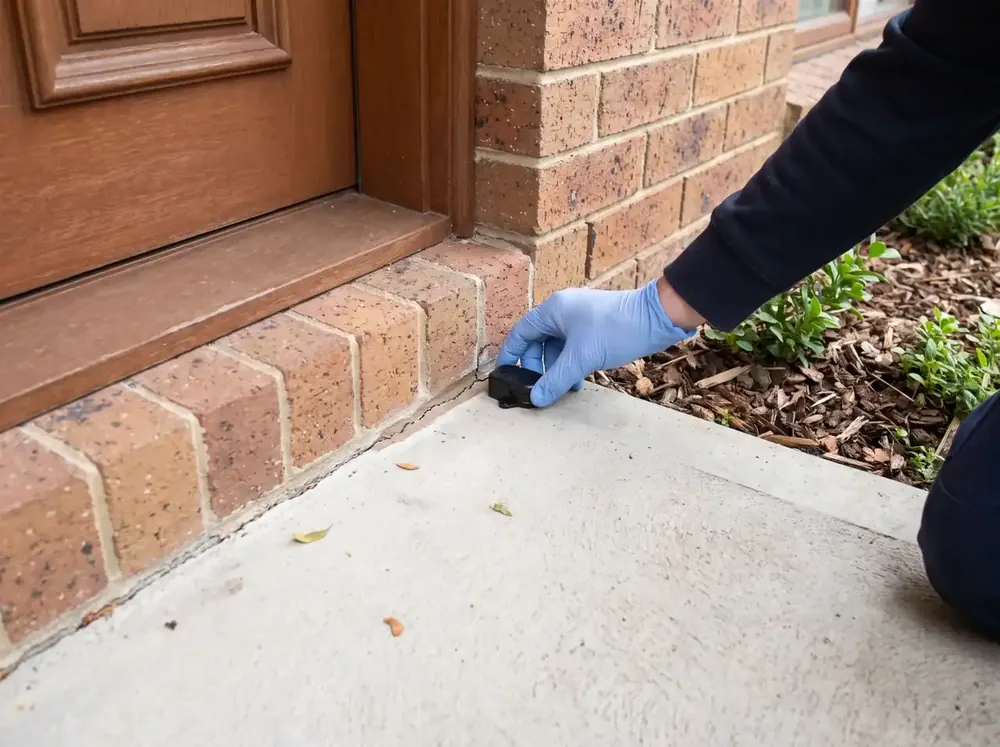
- Outside: the base of the walls, weep holes, pipe and cable entries, door thresholds, under eaves, around window frames and across the meter box and bin area.
- Inside: cracks, voids and cupboard interiors where activity has been seen, with gel and dust rather than open surface spraying in kitchens.
- Roof space and subfloor where there is safe access and a reason to go in.
- Sheds, garages and a carport where they sit against the house, which is where huntsman and redback populations usually start.
- Web and egg sac removal from eaves, window reveals and outdoor light fittings.
What makes a treatment hold is the part most people skip reading: the conditions around the house. Mulch piled against brickwork, firewood stacked on a wall, a dripping outside tap, shrubs touching the gutter line and a bin that is never rinsed all keep feeding the problem no matter what gets applied. Tim points those out on the day, in plain language, because fixing two of them is often worth more than a second treatment.

Scope
Which pests are priced on their own?
Rodent work, bed bugs, wasp nests, fleas, mosquitoes and moth jobs all carry their own quote, because each needs different equipment, different products and usually a different amount of time. They are not excluded from Tim's work. They are simply not part of the standard three-pest visit, and bundling them would mean everyone paying for work most houses never need.
Being clear about this up front avoids the most common complaint in the trade, which is a householder discovering on the day that the mouse problem is an extra line on the invoice.
| Pest | Where it sits | Why |
|---|---|---|
| Ants | Included | Baiting and a perimeter band, same visit, same access |
| Cockroaches | Included | Gel and dust into the same voids being treated anyway |
| Spiders | Included | Web clearing and external work overlap completely |
| Rats and mice | Quoted separately | Trapping, proofing and return visits, often over weeks |
| Bed bugs | Quoted separately | Room-by-room inspection, household preparation, a second visit |
| Wasps, fleas, mosquitoes, moths | Quoted separately | Nest work, floor coverings, breeding sites and stored goods each need their own method |
Four jobs are referred on instead of quoted. Termite work calls for a licensed timber pest specialist. Possums are protected under the Wildlife Act, so only a licensed handler may deal with them. A swarm or a hive should go to a beekeeper. Bats go to a wildlife rescue group. You are told which of the four applies over the phone, rather than after a call-out. Method detail for the three included pests sits on Tim's ant control page, his cockroach control page and his spider control page.
Plans
Does your house actually need a yearly visit?
Most do not, and that is the honest answer even though the other one pays better. A plan earns its keep on properties that reload from outside: large blocks with a lot of fencing, a boundary onto a reserve, a creek or a paddock, weatherboard houses with open subfloors, and anywhere planted thickly right up to the walls.
The question to ask yourself is simple. Over the last two summers, have the same pests turned up at the same time of year in the same parts of the house? If the answer is yes twice, a booked visit ahead of the season is cheaper and calmer than ringing in January. If the answer is no, you had one problem and it got dealt with, which is how it goes for the majority of Melbourne homes.
One visit suits you
A townhouse, a unit or a newer brick home with one problem and a clear cause. Treat it, fix the two conditions behind it, and move on.
A yearly slot suits you
The same ants every November, spiders every autumn, a garden that feeds the house, or a boundary with bushland or open ground.
Nobody needs this
Quarterly spraying of a tidy suburban house with nothing happening in it. That is a subscription, not a pest plan.
If you do take a yearly arrangement, get four things written down before you agree: which month the visit falls in, which pests it covers, what happens if something appears between visits, and whether that extra attendance is included or billed. A plan that cannot answer those is just a recurring charge with a treatment attached. Whether Tim offers a formal annual arrangement, and on what terms, is [annual plan terms to confirm with the client].
On the day
What happens when Tim turns up?
An inspection, then treatment, then instructions. Expect the first part to take a while: under the sink, behind the kickboards, through the laundry, around the window frames, along the outside walls and into the roof or subfloor where there is access. What gets used is decided by what turns up, not loaded onto the van beforehand.
- Walk and lookInside and out, with questions about what you have seen, where and at what time of day. Your observations usually beat anything found on the day.
- Treat what is thereGel and dust into cracks and voids indoors, a band and bait outside, webs and egg sacs cleared from eaves and reveals.
- Explain the aftercareWhen to return to treated areas, which spots not to wash, where pets should be, and what to expect over the following fortnight.
- Leave a recordWhat was found, what was applied and where, plus the conditions worth fixing around the property.
Preparation on your side is modest. Clear the benches, put food and utensils away, lift pet bowls off the floor, move anything stacked hard against the outside walls, and leave the side gate open and the dog secured. If there is a roof hatch or a subfloor access point, say where it is when you book so time is not spent hunting for it.
Expect activity to rise before it drops. Ants recruit heavily to new bait for a couple of days, and cockroaches disturbed out of a void will be more visible for a week. Both are signs the treatment landed. The spots that were treated should be left unwashed, because mopping an edge or wiping a hinge removes the product you paid for.

The figure
What moves the price of a home treatment?
Floor area, storeys, how much of the property is accessible, how long the problem has been running and whether anything beyond the standard three pests is involved. All of that can be worked out on the phone, which is why a quote changing when the technician arrives is a choice rather than a surprise.
A unit or townhouse, one storey, clear perimeter, a single pest caught early and nothing stacked against the walls.
Three or four bedrooms, a yard, a shed, the usual three pests and a roof space that can be reached.
Two storeys, high eaves, a long boundary, a closed subfloor, detached structures, or a population that has been sprayed repeatedly already.
Seasonality matters to the booking more than to the price. Melbourne households meet ants and cockroaches from spring through the warm months, spiders become obvious in autumn when the males move about, wasp nests peak in late summer, and rodents start pushing indoors as the first cold weather arrives. A treatment put down in early spring meets a smaller population than the same treatment in February.
Tim gives you a single figure, waits for you to approve it, and bills exactly that. On covered treatments the 3-month re-treatment guarantee means the same pest returning to the same treated area is dealt with again at no extra cost. Figures by pest and by property type sit in the Melbourne pest control cost guide. Read it if you are holding two quotes and trying to tell them apart.
Booking
How do you get a visit booked?
Describe the property and the problem together. Suburb, how many bedrooms, single or double storey, what you have been seeing, where, and for how long. From that Tim can usually give you the plan and the price without attending first, and offer a time inside the same week.
Mention anything that changes access or product choice: a dog that lives outside, a fish tank, a bird, someone pregnant or asthmatic in the house, a locked side gate, or a roof space nobody has opened in years. None of it is a problem. All of it is easier to plan for before the day than to work around on it.
Get a quote
Property details and what you have been seeing. A plan and a figure settled before anything is locked in.
Ask Tim about a home treatmentSee the whole range
Nine pests, one licensed technician, across Melbourne and roughly 40 km out from the city.
Look at Tim's pest control workIf you have seen more than one pest, list them all on the first call. The three standard ones go into a single visit, and anything extra gets priced alongside rather than becoming a second booking a fortnight later.
Questions
Questions Melbourne homeowners ask about general treatments
What does a general treatment include?
Ants, cockroaches and spiders, treated inside and outside in one visit. That covers the external perimeter and entry points, targeted indoor work in cracks and voids, roof space and subfloor where access allows, and web and egg sac clearing. Other pests are quoted on their own.
Is an annual plan worth paying for?
Only if the same pests keep returning to your address each season, which is a minority of homes. Large blocks, properties beside bushland or open ground, and houses with open subfloors benefit most. For a tidy suburban home with one problem, a single treatment is the better spend.
Do we have to be out of the house?
Not for long in most cases. Much of the work is baiting and dusting into voids, and that does not need the building emptied. Where broader interior work is needed, the re-entry time for that particular product is given when the job is quoted, not announced on your doorstep.
How soon will we see a difference?
Expect a brief rise in activity over the first few days, then a steady fall through the following week or two. Baits work by being carried back to the nest, so the result builds rather than arriving instantly. If nothing has changed after a fortnight, ring and say so.
Can you do a rental or an investment property?
Yes, for owners, managers and renters alike. Access and notice are arranged with whoever holds the keys, and a written record of the visit is issued so it can be passed on to the other party. Treatments timed to the end of a tenancy are handled a little differently.
Which time of year is best for booking?
Early spring suits most homes, because it puts the treatment down before ant and cockroach numbers build. Autumn is the sensible time if spiders or rodents are your recurring problem. Any month works for an active problem, and waiting for a tidier season is rarely worth it.
Not sure whether you need a plan or a visit?
Describe the property and what you have been seeing over the last two summers, and Tim will tell you which of the two is the sensible spend.
Sources: the Better Health Channel on choosing a pest control service and Victorian pest control licensing.