
Speech and Language Development
The years before school are when talking and understanding grow most quickly, and when support has the greatest impact if a child needs it. This guide explains what to expect at each age, when to wait and when to act with a late talker, the red flags worth taking seriously, and how speech therapy for preschoolers works alongside childcare.

Language is the foundation for friendships, learning and later reading, so it is natural to watch it closely. It is also one of the areas where children vary most. Some talk early and constantly; others understand everything and say very little until one day the words tumble out.
Speech and language are related but different. Speech is how clearly sounds are made. Language is understanding and using words and sentences to share ideas. A child can have difficulty with one, the other or both.
This guide covers typical development, what to do about late talking, when to seek help and how speech pathologists and educators work together. For other areas of development, see our child development hub.
How language develops, birth to five
Language develops in a predictable sequence, though at different speeds. Babies coo, then babble; toddlers say first words, then join them; three-year-olds talk in sentences; and four and five-year-olds tell stories and explain ideas. At every stage, children understand more than they can say.
It starts with listening. Newborns already prefer their parents' voices, and babies learn the sounds of their home language in the first year.
Gestures come before words. Pointing, waving and showing are early communication and predict later talking.
Conversation drives learning. Back-and-forth exchanges, even with a babbling baby, matter more than the number of words a child hears.
Play is where much of this happens. Pretend games, building together and simple turn-taking give children real reasons to use words.
Children learning two or more languages follow the same path, sometimes mixing languages along the way.
The sequence
- Babies
- Coo, babble, gesture
- Toddlers
- Words, then word pairs
- Threes
- Sentences and questions
- Fours to fives
- Stories and explanations
 Every word counts
Words expected at each age
First words usually arrive close to the first birthday; use around fifty words and join two words by about two, speak in short sentences by three, and tell simple stories by four or five. These are averages across a wide normal range, not cut-offs, and understanding is just as important as talking.
| Around | Understanding | Talking | How clear |
|---|---|---|---|
| 12 months | Knows own name and familiar words | A first word or two, plus gestures | Mostly babble |
| 2 years | Follows simple instructions | Around 50 words, joins two words | Roughly half understood by strangers |
| 3 years | Understands questions like "where?" and "who?" | Short sentences, asks questions | About three quarters understood |
| 4 years | Follows longer instructions | Longer sentences, tells events | Nearly all understood |
| 5 years | Understands stories and time words | Tells stories in order, explains | Clear, some tricky sounds remain |
Understanding is often the better early guide. A toddler who follows instructions, points to named pictures and responds to questions is building a strong base, even with few words.
Some sounds take longer. Sounds like "r", "th" and blends such as "sp" can remain tricky until the early school years.
Clarity guides are rules of thumb, useful for noticing when a child is much harder to understand than peers.
Age-by-age detail is in our 1 to 2 years guide and the other milestone pages.
Late talkers: wait or act
If your toddler is a late talker, acting early is usually wiser than waiting. Many late talkers catch up on their own, but it is impossible to know in advance which ones will, and early support is simple, playful and effective. A speech pathology assessment gives you a clear answer rather than months of wondering.
Good signs in a late talker include understanding well, using gestures, pointing, copying sounds and showing interest in people.
Signs that make assessment more urgent include little understanding, few gestures, limited interest in others, or a family history of speech difficulties.
Screens are not a substitute for conversation. National guidelines recommend no screen time before two, partly because it can crowd out the talking that builds language.
A hearing check is a sensible early step, because even mild hearing loss from ear infections can slow speech.
Reduce background noise when you talk together. Turning off the television during play and meals makes it easier for a child to tune in to speech.
Get down to your child's level and follow their interests. Talking about what they are already looking at is far more effective than asking them to name things on demand.
Meanwhile, keep talking, reading and singing. Home strategies help every child, whatever the outcome.
"Wait and see" advice is common, but many speech pathologists now prefer "check and see".
Red flags worth acting on
Red flags are signs that a child would benefit from a speech pathology assessment. They include no babbling by around twelve months, no words by eighteen months, not joining words by two, being very hard to understand at three, stuttering that worries the child, and any loss of words or skills.
Social communication matters as much as words. A child who rarely looks at people, shows little interest in sharing attention or does not respond to their name should be checked, whatever their vocabulary.
Trust your instincts. You know your child best, and asking early is never an overreaction.
Stuttering is common as language develops quickly, often between two and five. Many children outgrow it, but seek advice if it lasts more than a few months, involves visible tension, or upsets your child.
Speech difficulties can affect confidence and friendships, so support helps with more than words.
How educators support language all day
Educators support language throughout the day, not just at story time. They talk with children during play, meals and routines, name what children are doing and feeling, expand short phrases into longer ones, read and sing daily, and give children time to answer. In a busy room, that adds up to thousands of conversations.
Commenting rather than questioning: "You built a tall tower" invites a reply without pressure.
Expanding: if a child says "big truck", an educator might answer "a big red truck carrying sand".
Songs and rhymes build rhythm, memory and sound awareness.
Educators also notice children who are quiet in groups or hard to understand, and can gently raise it with families so nothing is missed.
Group time teaches listening and taking turns to speak, skills that matter for school.
At our centre, our preschool program includes Reading Eggs, and all rooms share stories and conversation through the day.
Everyday language strategies
- Commenting, not quizzing
- Expanding short phrases
- Songs and rhymes daily
- Waiting for answers
How speech pathology works with childcare
Speech therapy for preschoolers works best when strategies continue between sessions. A speech pathologist assesses your child, sets goals and runs play-based sessions; educators and families then use the same strategies through the week. Some therapists visit children at their centre, where they can see them in everyday play.
Many therapy blocks run weekly for a set number of sessions, then review progress. Goals are usually small and specific, such as using two-word phrases in play.
Sessions for young children are play-based, using toys, books and games to practise sounds, words or conversation.
Parents are part of the team. Many therapists coach families to use simple strategies at home, because a few minutes of practice every day beats one session a week on its own.
With your permission, therapists can share goals with educators so the whole day becomes practice.
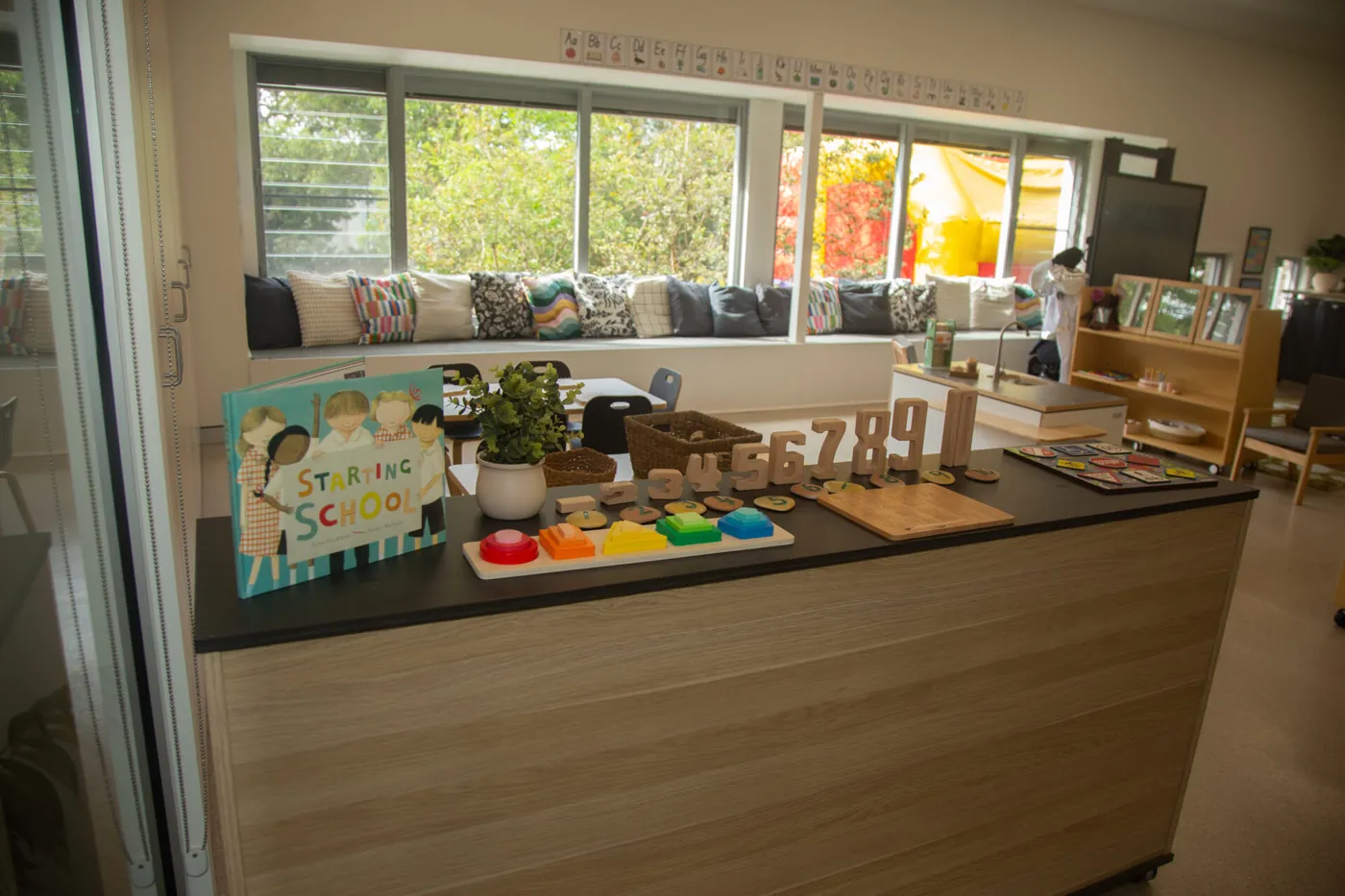
Our centre has a dedicated therapy room, so a visiting therapist can run sessions in a calm room without your child leaving the centre.
We also host parent events on language; a speech pathologist has co-presented one of our parent masterclasses. Upcoming sessions are listed on our events page.
Read about our wider approach in our inclusion guide.
Getting a referral
You do not need a GP referral to see a private speech pathologist; you can contact one directly. A GP is involved if you want Medicare-subsidised sessions through a GP plan for eligible children, and public community health services have their own intake processes. A family doctor or child health nurse can point you to local options.
Find a certified practising speech pathologist through Speech Pathology Australia.
Ask about the approach before booking. Some speech pathologists specialise in young children and work mainly through play and parent coaching.
Private health insurance extras may cover part of the cost of private sessions, depending on your policy.
Children with developmental delay may be able to access early supports through the NDIS early childhood approach.
Waiting lists for public services can be long, so it is often worth getting on a list early while you try home strategies.
Bring notes to the first appointment: examples of words and sentences, what your child understands and anything educators have noticed.
Speech and language, answered
How many words at two?+
Many two-year-olds use around fifty words and are starting to join two words together, such as "more juice". The range is wide, and understanding matters as much as talking. If your child has far fewer words, is not joining words, or understands little, a speech pathology assessment is worthwhile.
Does childcare help speech?+
Quality childcare can support speech and language, because children hear rich conversation, stories and songs all day and practise talking with educators and friends. It does not replace speech therapy when a child has a difficulty, but it gives plenty of chances to use the strategies a therapist recommends.
Do I need a GP referral?+
No, you can see a private speech pathologist without a GP referral. A GP referral is needed for Medicare-subsidised sessions under a GP plan for eligible children, and public services may have their own referral rules. Your GP or child health nurse can help you choose the right path.
Explore our centre in St Ives.
Rich language, every day
Visit and see how conversation fills our rooms.