
Kindergarten in NSW Explained
Kindergarten NSW style is year one of primary school, not a preschool program. A child who has had their fifth birthday by 31 July may begin in Term 1 of that year, and the law requires every child to be enrolled in school by the day they turn six. This guide explains the rules, the dates and how to enrol.

If you grew up in another state or country, the word Kindergarten can be confusing here. In NSW it is not a play-based program for four-year-olds; it is a full school year, in a primary school, with a teacher, a uniform and the NSW curriculum. The year before it is preschool.
Families often use "kindy" for both, which does not help. In this guide, preschool always means the year or two before school, and Kindergarten always means school.
The confusion is so common that many schools and preschools explain the terms at their information evenings. Knowing them now will make those evenings much easier to follow.
It also affects searches online. Advice about "kindergarten age" written for Victoria or Queensland is usually about the year before school, so check which state a source is writing for.
That difference affects when your child starts, how you enrol, and what the year before school should look like. This guide covers the terminology, the age rules, the enrolment process for NSW public schools, the choice between starting at four-and-a-half or waiting, and local schools near St Ives. For more starting-school reading, see our guides for NSW families.
Kindergarten in NSW is school, not preschool
In NSW, Kindergarten is the opening year of primary school, taught by a qualified teacher to the NSW syllabus, and it comes before Year 1. The year before school, usually at age four, is called preschool, and it happens in a preschool or a long day care centre with a preschool program. Kindergarten NSW style is compulsory schooling's opening year for most children.
Kindergarten children learn across the NSW primary key learning areas: English, Mathematics, Science and Technology, Human Society and Its Environment, Creative Arts, and Personal Development, Health and Physical Education.
Kindergarten runs on the school calendar, starting in late January, with four terms and school holidays.
The school day is usually shorter than a long day care day, running roughly through the middle of the day, so many working families add before and after school care. Our centre also offers before and after school care.
Children wear a school uniform, attend school hours and learn literacy, numeracy and other subjects from the NSW syllabus.
In the first weeks, NSW public school teachers use the Best Start Kindergarten assessment to see where each child is with early literacy and numeracy, so teaching can start from the right place.
Teachers also get to know each child's interests and friendships in those first weeks, and many schools pair new Kindergarten children with an older buddy from the senior years.
Class sizes and routines differ from preschool. There is more sitting, more instruction and more independence expected, which is why the preschool year focuses on those skills.
Most schools hold orientation sessions for new Kindergarten children towards the end of the year before.
Kindergarten is a big step up in independence. Children manage their own bags, lunches and toilet trips, move between classroom, library and playground, and follow a timetable set by the school.
Preschool, by contrast, follows the national Early Years Learning Framework and is play-based, though good preschool programs build many of the skills children use in Kindergarten.
NSW, in order
- Long day care
- Babies to school age
- Preschool
- Ages three to five, before school
- Kindergarten
- First year of primary school
- Year 1
- Second year of primary school
 Kindergarten means school
Why the word means something different in other states
The word means something different elsewhere because each state kept its own names when schooling developed. In Victoria, Queensland, Western Australia and Tasmania, "kinder" or "kindergarten" usually means the year before school. In NSW and the ACT, Kindergarten is itself a school year. The national curriculum calls that first year Foundation.
| State or territory | Year before school | First year of school |
|---|---|---|
| New South Wales | Preschool | Kindergarten |
| Australian Capital Territory | Preschool | Kindergarten |
| Victoria | Kindergarten (kinder) | Prep |
| Queensland | Kindergarten (kindy) | Prep |
| Western Australia | Kindergarten | Pre-primary |
| Tasmania | Kindergarten | Prep |
| South Australia | Preschool | Reception |
| Northern Territory | Preschool | Transition |
The ACT shares NSW's naming, which is why families moving between Sydney and Canberra rarely get caught out; families arriving from Melbourne or Brisbane often do.
This matters if you are moving interstate, or reading advice written for another state. "Enrol for kinder" in Melbourne and "enrol for Kindergarten" in Sydney are different steps, a year apart.
If you are moving to NSW from another state, check your child's year carefully. A child who was in "kinder" in Victoria may be ready for NSW Kindergarten, not another preschool year.
Moving the other way, a child who finished NSW preschool will be looking at Prep in Victoria or Queensland, Reception in South Australia, or Pre-primary in Western Australia.
Cut-off dates also differ between states, so a child might start school in a different year depending on where they live.
For families from New Zealand, NSW Kindergarten is broadly comparable to the first year of primary school there, though entry rules differ.
International families should also note that NSW children usually start school younger than in many European countries, where formal schooling often begins at six or seven.
For children coming from overseas, NSW Kindergarten is broadly similar to a reception or first grade year elsewhere.
Starting age and cut-off dates
The rule has two parts. First, a child is eligible for Kindergarten in any year in which they reach five by 31 July. Second, school is compulsory from the sixth birthday, so no child can wait beyond that. That means children born between January and July have a choice of two starting years, while those born later usually start the year after they turn five.
- Earliest Kindergarten start
- Must be at school by
- Preschool year if starting at the earliest
| Date of birth | Earliest Kindergarten | Latest |
|---|---|---|
| 15 March 2021 | Term 1, 2026 | Term 1, 2027 |
| 31 July 2021 | Term 1, 2026 | Term 1, 2027 |
| 1 August 2021 | Term 1, 2027 | Term 1, 2027 |
| 20 November 2021 | Term 1, 2027 | Term 1, 2027 |
Families with twins or siblings close in age sometimes find the rule places children in different school years. The same rule applies to each child individually.
Birthdays close to the cut-off cause the most discussion. A child born on 31 July can be one of the youngest in their Kindergarten class, while a child born on 1 August will be one of the oldest the following year.
Children born in January are a special case. Because school starts in late January, a child with an early January birthday who waits a year would turn six before school begins, so they need to start in the earlier year.
The calculator applies the 31 July rule and the sixth-birthday rule. It shows dates, not advice about which year is right for your child.
The calculator runs in your browser only, and does not keep or share the date you enter.
The school year begins in late January. Exact term dates are published on the NSW Department of Education's school calendar.
Official details are on the department's starting school page.
How to enrol in a NSW public school
To enrol in a NSW public school, find your local school on the department's School Finder, then apply online or with the Application to enrol form. Many public schools have designated local enrolment areas that guarantee a place for children who live in them. Contact the school early in the year before your child starts.
- 1
Find your local school
Use the NSW School Finder to see which public school's enrolment area you live in.
- 2
Apply
Apply online where the school offers it, or complete the Application to enrol form.
- 3
Share health details
Include allergies, anaphylaxis and other medical information on the application.
- 4
Go to orientation
Attend the school's orientation or transition sessions later in the year.
Most schools ask for proof of your child's age, such as a birth certificate, and proof of your home address for local enrolment. Many also ask for your child's immunisation history statement.
If your child has an allergy, include it on the form and ask how the school manages it, because arrangements differ from early learning settings.
Tell the school early about any additional needs, so it can plan support for the first term.
| When | What usually happens |
|---|---|
| Terms 1 to 2 | Contact your local school, attend any information sessions and lodge your application |
| Terms 3 to 4 | Many schools run transition to Kindergarten programs over several weeks |
| Term 4 | Orientation days for children starting the next year |
| Late January | The school year begins |
Your local school may not be the closest one to your home, so check the School Finder rather than assuming.
Non-local enrolments depend on places being available and the school's criteria.
Keep a copy of everything you submit, and note any dates the school gives you for information evenings, interviews or orientation.
If you are considering more than one school, visit each during the year before. Most welcome prospective families at open days or by appointment.
Independent and Catholic schools run their own enrolment processes and timelines, often earlier than public schools, so contact them directly.
Questions about the year before school? Call us on (02) 7238 8668.
Choosing between starting at four or five
Children born between January and July can start Kindergarten at four-and-a-half or wait a year and start at five-and-a-half. The NSW Department of Education describes this as an individual decision, and suggests talking it through with your child's preschool teacher, carer, doctor or local school.
Think about your child, not their peers. Social confidence, independence and the ability to manage a school day matter as much as early literacy.
Consider how your child manages a long day. Kindergarten is tiring, and children who still need a daytime sleep may find the first term hard.
Some children are keen to go because older siblings or friends already have. Enthusiasm is a good sign, but pair it with the everyday skills that make a school day manageable.
Look at the practical side too. Starting school earlier ends long day care fees sooner, but adds before and after school care costs if you work long hours.
Siblings and friends can sway a decision, but try to keep the focus on your own child's readiness, not on what others in the family or class did.
Some families find it helpful to decide by the middle of the year before, so there is time to plan enrolment, transition sessions and any care changes calmly.
If you do decide to wait, plan the extra year thoughtfully. A strong preschool program keeps children challenged, so they arrive at school confident rather than bored.
Avoid deciding on age alone. Plenty of children born in autumn or winter thrive starting young, and plenty benefit from an extra year.
Ask the educators who know your child well; they see how your child copes day after day in a group, which is hard to judge at home. They notice how your child copes with routines, instructions and friendships.
Schools are set up for a range of ages. The department notes that teachers are trained to work with children regardless of their age or level of development.
Use our school readiness checklist to see where your child is now.
Worth weighing
- Social and emotional readiness
- Independence with self-care
- Coping with a full school day
- Your educators' observations
- What another preschool year offers
How preschool prepares children for kindergarten
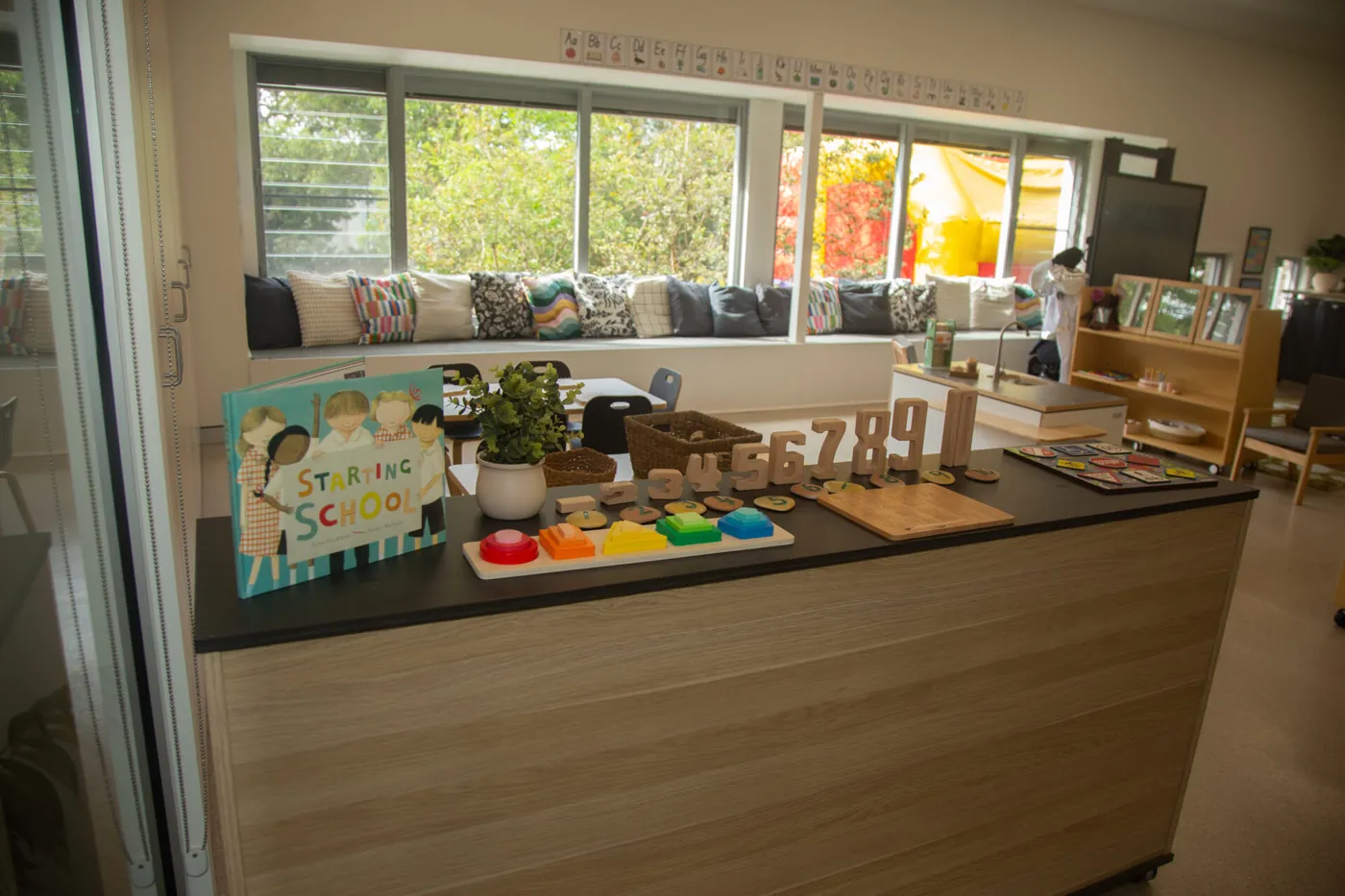
Preschool prepares children for Kindergarten by building the skills a school day depends on: listening in a group, following instructions, managing belongings and emotions, making friends, and early literacy and numeracy. Here, preschool describes the learning years just before school, delivered by community preschools and by long day care services with a preschool room.
- Independence: dressing, toileting, lunchboxes and belongings
- Listening and following two-step instructions in a group
- Early literacy: stories, sounds, letters and mark making
- Early numeracy: counting, patterns, shapes and comparing
- Friendships, turn-taking and handling disappointment
- Confidence to ask an adult for help
Families help too. Reading together every day, talking about school positively and practising small independent tasks at home all make a difference in the months before Kindergarten.
Those six areas mirror what Kindergarten teachers say helps most in the first term, and they are the backbone of a strong preschool year.
At our centre, the preschool year happens in our Inventors room, where our School Readiness Program runs alongside Reading Eggs and Mathseeds.
The skills that matter most for Kindergarten are often the least academic: opening a lunchbox, going to the toilet alone, putting on shoes, asking a teacher for help and coping when things do not go their way.
Talking positively about school helps enormously. Children pick up on how adults describe it, so framing Kindergarten as an exciting next step sets the tone.
Stamina matters too. A preschool year with longer days and regular routines helps children cope with the pace of a full school day and the tiredness of the first term.
A good preschool year also builds confidence in groups, so children are used to listening, taking turns and moving between activities on cue.
We work with local schools on transitions, so children arrive at Kindergarten knowing what to expect.
Visiting the school together before the first day, even just walking past the gate or playing in the grounds on a weekend, turns a big unknown into a familiar place.
With your permission, a preschool or centre can pass a Transition to School Statement to your child's new school, giving the Kindergarten teacher a head start on knowing your child.
Children in the year before school may also be eligible for NSW Start Strong fee relief. See our Start Strong page.
Local schools in the St Ives area
Public primary schools near our St Ives centre include St Ives Public School, St Ives North Public School, Gordon West Public School, Pymble Public School and Killara Public School. Which one your child attends depends on your home address and the school's enrolment area, which you can check on the NSW School Finder.
Families from further afield feed into schools such as Turramurra, Wahroonga and Lindfield Public Schools, among others.
Other public schools in the wider area include Hornsby North, Hornsby South, Waitara, Asquith, Warrawee, Roseville, Lindfield East, Chatswood, Artarmon, Willoughby and Castle Cove Public Schools.
Private and religious schools in and around the Upper North Shore have their own enrolment timelines, so if you are considering one, contact it well before the year your child would start.
When you visit a school, ask about its transition program, how Kindergarten classes are organised, and what the first week looks like for new children.
Always confirm your local school on the NSW School Finder, because enrolment areas do not always follow suburb boundaries.
For more detail on each school, read our guide to primary schools around St Ives.
Kindergarten, answered
Is kindergarten the same as preschool in NSW?+
No. In NSW, preschool comes first and Kindergarten is school. Kindergarten happens in a primary school and follows the NSW syllabus, whereas preschool is play-based learning in a community preschool or a long day care service before children start school.
What age does kindergarten start?+
NSW children usually begin Kindergarten aged somewhere between four-and-a-half and five-and-a-half. Eligibility depends on reaching five by 31 July of the school year, and enrolment becomes compulsory at six.
When is the cut-off date?+
It is 31 July. Reach five by then and a child can begin Kindergarten in Term 1 of that year; a fifth birthday from 1 August onwards usually means starting the next year instead, still before the sixth birthday.
Visit our St Ives early learning centre to learn more.
Make the year before school count
Visit our preschool room and ask about the School Readiness Program.